Henry talks about honesty, letting go of perfection and conversations with his grandad as he releases debut album ‘Bad Throw, Good Catch’.

“I only started listening to albums when I was 14 or 15; before that, I was just listening to songs. ‘Closing Time’ by Tom Waits was probably the first time I listened to an album all the way through,” Dermot Henry says. “I realised you can string some songs together and they can be more than the sum of their parts.”
The 23-year-old singer-songwriter has just released his debut album ‘Bad Throw, Good Catch’ via Island Records. The twelve tracks move through a tender strain of indie folk, pairing unvarnished vocals with lyrics that leave little hidden. There is an intimacy to the record that reaches beyond the songs themselves, with contributions from Henry’s family and friends woven into its arrangements. Their voices and instruments bring a sense of closeness to the album, making it feel rooted in the relationships that have shaped it.
“My ideas for songs come from conversations… I write down the things that have made me laugh out loud or made me think.”
There is a certain openness to the way Henry talks about making music, as though songwriting was something he arrived at through instinct rather than intention. What began as a childhood ambition to play in a band gradually became something more personal. “I started writing songs because I wanted to be in a band. I was obsessed with The Libertines when I was a kid, and I just wanted to be like them and write music like that. And then I realised I loved it, and it felt like the way I should be expressing myself.”
That instinctive approach has stayed with him. Henry does not seem particularly interested in forcing a song into existence, preferring to give ideas the time and space to find their own shape. “I am not able to sit down and force things to come out; I kind of wait around until they appear,” he explains. “A month after I had the initial idea for ‘I Love You, That’s All’, I just sat down, and it all came out. I try not to labour on things too much, and if it’s coming, I try and just push it out as quickly as possible.” He pauses for a moment. “It involves a lot of self-trust. I need to trust my future self to finish the ideas.”
Often, those ideas begin with other people. Henry has a particular affection for the small details of conversation, especially the unexpected turns of phrase that might otherwise pass unnoticed. “My ideas for songs come from conversations with people. I write down the things that have made me laugh out loud or made me think about something,” he shares. “My grandad, who I speak to a lot, is good for that. He is quite good at the old one-liner. Hanging out with him is an absolute farm for my songwriting because he just comes up with so many great phrases.”
That attentiveness to other people also informs the way he thinks about writing honestly. Although his songs often begin with very personal experiences, he is conscious of how they might open out into something others recognise. “When I started writing music, I remember having a conversation with my dad, and he told me it was too personal; these lyrics are too personal. I think there’s a balance in writing your experience whilst sort of not making it so hyperspecific that no one else can relate,” he shares.
“I think I’m trying to find, not deliberately, but some kind of common ground in the things that are happening that other people can relate to, not for that purpose, but that ends up being the byproduct of it because I think I am trying to understand these experiences through an expanded lens. That makes me sound like a huge prick,” Henry laughs.
“The environment felt so comfortable, and I felt so trusting with the people I was working with.”
That sense of connection extends beyond the writing itself. ‘Bad Throw, Good Catch’ is full of familiar voices and contributions from the people closest to him, giving the album a distinctly personal character. “My mum was desperate to sing on it. She has a lovely voice and adds so much to the song. Me and Dom [Monks], the producer, were trying to figure out who to ask to sing on the song, and then I was like, “Why don’t we just ask my mum?” It just made sense because the studio we were recording in was really close to where I live, so she came in,” he says. “My grandad is not much of a singer, but he was in the army, and he always sings this song that his regiment sang. I just took a voice note of him singing it, and we were looking for something to go in that instrumental bit, and it just fit so perfectly.”
The presence of family and friends on the record feels less like a creative choice than a natural extension of the way Henry makes music. “My brother plays the drums, my girlfriend Bella did the cover artwork, and loads of my friends sang or played on the album, and it was always my desire to do that. I look back on the time spent recording this album with such fondness. It was such a wonderful experience.”
The same openness carried into the visual side of the project. Rather than trying to dictate how the album should be interpreted, Henry gave Bella the freedom to respond to it in her own way. “My brief to Bella was just to listen to music and see what she wanted to do. It helped me see the music differently to have that perspective on how it made someone else feel in such an obvious way. When someone listens to [the album] and creates something like that, it was very – is vindicating the right word? It made me feel good because I was like, oh, this is how I want people to feel.”
For all the trust he placed in the people around him, deciding what belonged on the record proved a different kind of challenge. The album took shape gradually, with its identity only becoming clear once the songs had begun to gather around one another. “Choosing the tracks was the hardest part of making the album. When we started making the album, my brain wasn’t really visualising a destination. It felt like we were kind of letting the songs lead, and we got to the end, and we recorded all these songs and reflecting back on them, you kind of realise what direction they’re all pointing in. Picking the songs took a while because we were trying to be intentional about it, because we had recorded 27 songs and only 12 made it to the album.”
“I think I naturally already lean towards the contrast between being goofy and sincere.”
There is a particular fondness in the way Henry talks about the music that has stayed with him. His influences are less about adhering to one sound than finding inspiration in unexpected contrasts, where humour and sincerity can sit comfortably alongside one another. “My brother is going to have a go at me because I have been talking about this album so much recently, but there is this album called ‘Rain Dogs’ [by Tom Waits] that I started listening to halfway through making this album. It is just so creative and insane, and half of it is like demented sea shanties, and the other half of it is really beautiful. There was something captivating about the contrast or the contradiction between those two things and how they exist in the same way. I think I naturally already lean towards the contrast between being goofy and sincere, and the balance of all these things. And I mean, ‘Dragon New Warm Mountain I Believe in You’ by Big Thief is like the recorded music Bible.”
That appetite for music that can hold seemingly opposing qualities together also informs his wider listening habits. “I also listen to a lot of 90s hip-hop music; there is something about the comedy and the directness of it. I love A Tribe Called Quest.”
That appreciation for directness extends beyond music. Henry speaks about language with the enthusiasm of someone who is as interested in how something is said as what is being said. “I am a big reader. I finished reading ‘Giovanni’s Room’ by James Baldwin literally ten minutes ago. It’s so fucking sad, oh my god. My favourite thing about books is when they’re super direct and don’t have much flowery language. I don’t want to sound like a wanker, but I have to bring up Hemingway. I started reading his books a couple of years ago, and I just love how he kind of meanders around and just speaks in really plain language, and then all of a sudden you’re crying, and you don’t really know why. There is so much power in that.”
“The biggest learning process for me on this album was learning to trust and let go.”
It is perhaps fitting, then, that one of the biggest lessons he took from making the album had less to do with songwriting than with learning when to step back. For someone whose lyrics are so personal, allowing other people into the process meant placing a different kind of trust in them. “The biggest learning process for me on this album was learning to trust and let go. It was recorded mostly live and to tape with other musicians playing. I thought I would be more precious about my own songs. I think that surprised me. The environment felt so comfortable, and I felt so trusting with the people I was working with, and I felt like I could really let go of how I thought my voice sounded or my piano playing. I think I let go of the idea that the recordings having to be the ultimate version of a song,” he explains. “Dom is a very wise fella, and realising that it’s a song, that’s what it is, and it can exist in many different ways, whether that’s live or recorded. I think letting go of it being the absolute apex of perfection, which doesn’t exist in my experience so far, was big for me.”
“We’d play a song a few times and everyone would figure out what they were doing. Because I was playing with such amazing musicians and people that I trusted, I really didn’t feel that sort of pressure of things having to be different. It always felt like a really wonderful place. Everyone was being quite vulnerable and honest, and that environment made [recording the album] the easiest thing in the world.”
That trust seems to have shaped the emotional character of the record, too. For all the moments of uncertainty and sadness, Henry keeps returning to the things that make those feelings easier to carry: friendship, community and the people who stay.
“It is so easy to feel hopeless and dreading about everything, and there are moments on this album that are like that, but the throughline of it for me is community and shared experiences and love and friendship and all those lovely corny things. I have no easy intention to want to deliver to someone listening to, but the album was written and created with hope and love so I would hope that was what people came away with.”
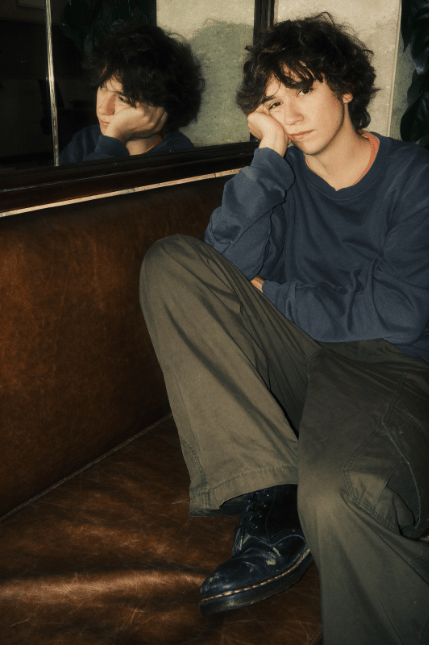
“Honesty is the most important thing. That’s what makes you you.”
Perhaps surprisingly, asked to choose between music and writing, Henry doesn’t hesitate: he chooses writing. “If I didn’t write music I would pursue some other form of writing. I love music, and it is my favourite thing in the whole world, but language is so amazing,” he says. “I speak a bit of French. I hesitate to say that. I lived in Paris for a year, but it’s been a while now, so I am a bit rusty. I believe everyone should learn a different language. Even when I read books that are translated, it feels as if the language is arranged slightly differently, although I’m reading it in English.”
Away from the people and places closest to him, distance offered another way of understanding them. Half of the album’s songs were written in Paris, where being removed from familiar surroundings gave Henry a different perspective on home.
“It is easier to write about things that are close when you’re far away from them.”
“The songs are all quite honest and reflective of my relationships with people and place. I wrote these songs in a flurry, and coming back to them more thoughtfully was emotional sometimes. There is a song called ‘Newest Old Friend’ that was written about my friend Katt, who plays cello on the album, and a couple of my other friends. I remember Katt and I were sat in the room, and we recorded it facing each other, and then we were just crying afterwards. It brings the feelings of those songs closer to me than when I wrote them, which is cool.”
Ultimately, everything seems to come back to honesty. Throughout the conversation, Henry returns to the importance of allowing songs to remain personal, even when that means exposing parts of himself he might otherwise keep private. “Honesty is the most important thing. That’s what makes you you. If something feels uncomfortable because it feels too [personal] or if it doesn’t feel like lyrics that someone else would write, it’s because it came honestly from you.
That commitment to honesty is not always comfortable, particularly when a song reveals more than he initially intended. For Henry, the moments that feel most exposing can also be the ones that matter most. “I have a song called ‘Now, Forever’ that the album ends with, and it didn’t sit right with me for a while. Near the end of the process, Dom played it again, and we were both in tears. It was the song where I was at my most naked, and that made me uncomfortable because it was really honest.” It is this willingness to leave the uncomfortable parts untouched that gives ‘Bad Throw, Good Catch’ its pull, making it a quietly affecting debut whose most exposed moments leave the strongest impression.