With ‘Fangs’, HMLTD are looking to renovate the Gothic canon.
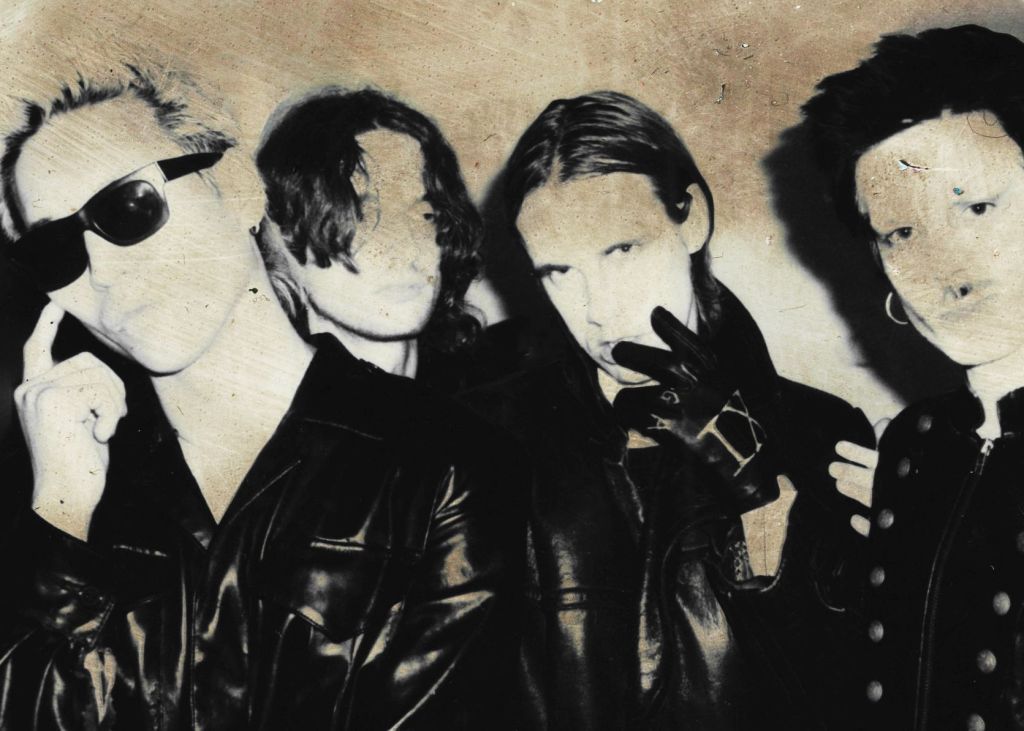
“We’ve always been kind of a goth band at heart,” Henry Spychalski, the lead singer of HMLTD told me in a conversation earlier this month. “On this record we’re returning to again the things that influenced us in our early period.” Written in London and recorded in a half-ruined 19th century chateau in the Loire Valley during October and November of last year, ‘Fangs’ is HMLTD’s first album since 2023. It’s also the debut of the band’s new lineup: founding members Spychalski and Duc Peterman have been joined by Andrei Martynchyk and Theo Spark.
Theoretically, ‘Fangs’ is classic HMLTD. It’s a minefield of references to various philosophical and literary texts pulled through the wringer of pop culture in a cavalcade of imagery that dips back and forth between panic-attack-inducing sensory overload and sucker-punches of apt situational analysis. Musically, it’s new territory for the band, a sonic blend of goth fused with hardcore, black metal and hyperpop that HMLTD call “Ubergoth.” It’s hectic and harsh, sharp and urgent, Bauhaus meets ‘Brat’ – an album to dance to, preferably in a dark, crowded club. The eleven tracks, heavily populated with vampires and their prey, run the gamut from ‘Chateau Vamp Freestyle’, (a stylized period-piece of ghost-tavern bounce descending into Weimar cabaret) and ‘Shudder’ (a slick pop hook with deliciously dark edges) to ‘Blitzkrieg’, (a pulsating, layered track with manically witty lyrics delivered at correspondingly maniacal speed). ‘Fangs’ culminates in ‘Sorry for Laughing’, a fitting collaboration with Sébastien, lead singer of the legendary band Corpus Delecti, who Spychalski refers to warmly as the band’s “French goth dad.”
“With this record, what we wanted to do was to contribute to the gothic cannon and the gothic tradition but to renovate and update what that meant and to do something new rather than something derivative within it,” Spychalski explained. “I think that what we tried to do in general with this album was to apply to the gothic and to goth music the same treatment that hyperpop applied to pop, i.e. to make something hyper-goth. We just felt that the term Ubergoth was more appropriate because of the Germanic aspect of it… that led naturally to Gotherdammerung, which is play on Wagner’s Götterdämmerung. ‘Twilight of the Gods,’ becomes ‘Twilight of the Goths.’ It’s just kind of a fun play on words, but also Wagner was a major influence on the record in various ways. There’s lots of references to him sprinkled throughout. We liked this idea of a kind of final battle of the goths.”
There are several layers of reasoning behind the choice to center the blood-sucking undead as a central theme. “Vampirism is very much linked to this idea that we have just become consumers and that consumerism has really reached this insane point now… We’re all just totally addicted to consuming the slop and that consumption really defines our existence,” Spychalski explains. “I think that kind of ontology where your existence is defined by endless consumption and is never satisfied and where there’s infinite appetite, really is a form of vampirism.” (Both the video for ‘Blitzkrieg’ and the lyrics to ‘Chateau Vamp Freestyle’ include nods to Paul Morrissey’s cult-favourite horror-film-slash class commentary ‘Blood for Dracula’, in which Udo Kier appears as sleazy, sickly vampiric nobleman eventually dispatched by a Communist handyman, played by Joe Dallesandro.
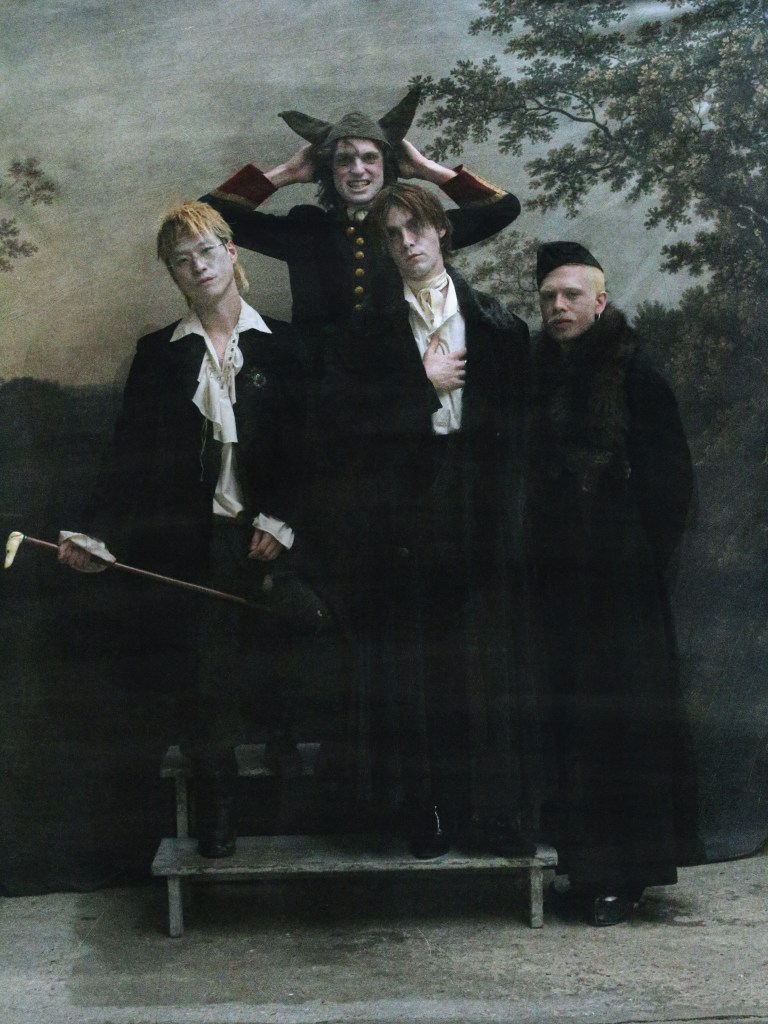
As the band’s main lyricist, Spychalski’s long-held enthusiasm for the Romantics informed the album’s darker leanings. So did the books he was reading whilst the band were holed up in the crumbling French chateau last fall – namely Nick Land’s ‘The Thirst of Annihilation’ and Gruppo di Nun’s ‘Revolutionary Demonology’. Of the latter, Spychalski said: “That book was exploring lots of ideas of the Gothic, of creating a kind of Gothic revolutionary politics for a Gothic insurrection. This idea of Gothic insurrection was basically (I think – the way I interpreted it) making this claim that the Gothic emerged in the 19th century kind of in response to Enlightenment rationality and this idea that man would finally achieve mastery of the world, and that we understood everything. The Gothic was the return of the superstitions of the past and all the ghosts and antiquities that we’d believed that we buried with the medieval period, kind of coming back to life and challenging our sense of mastery over the world… In the 21st century the rise of a form of capitalism that we no longer understand (or are able to control) as well as technologies that have also accelerated beyond our control (in the form of AI), I think we’re increasingly living in a period again like the pre-Enlightenment period where we no longer understand the world and where the average layperson no longer has mastery of the world. He no longer can explain its machinations. And when you can no longer explain or understand the world, that’s when mythology becomes necessary… as a means of mapping it, of trying to understand it. I think that it’s high time to resurrect the gothic and to resurrect these symbols and these archetypes that you have in the gothic as a means of trying to understand the world around us, of trying to map the world around us, to make sense of it, be that if you’re talking about AI, or you’re talking about capital and exploitation.”