We speak with the duo about bedroom recording and their resourceful approach as they release ‘Wild Troutflies’ via Private Regcords.
A 2026 report by the Cultural Learning Alliance identifies an ‘Arts entitlement gap’ in the UK, meaning, ‘Where a child grows up and their social economic status are significant social determinants in whether they will access [and] pursue] Arts qualifications’. This disparity had previously been discussed in the context of primary education, but the latest report describes how this gap ‘has been travelling upwards as children progress through the system’. It seems we are seeing ripples of this disparity in current British music, especially given so many of Britain’s most promising new exports have developed in the context of conservatoire training. This is particularly pronounced in the maximalist orchestral stylings of Black Country, New Road and the many comparable acts who have found success in their wake. The combination of chamber instruments and virtuosic affects juxtaposed with hard-edged post-punk and post-rock overtones has become a signature of British alternative music in the past few years. For all that is to be gained from the stylistic innovations of this vogue, its entrenchment has by nature tended to amplify acts with privileged access to orchestral instruments and formal training. At the same time, living costs and inequality are increasing while the prospects for earning money through a career in music have grown ever more precarious. As such, conservatoire graduates enjoy a degree of freedom and access that is becoming increasingly rare outside of that context. In the long run, this shift in representation will only the intensify inequalities defining this evident ‘entitlement gap’.
It has been encouraging, therefore, to see acts finding success while centring a DIY ethos and sound that is more widely accessible to aspiring artists. This has been common to the breakthroughs of as diverse a crop of bands as The New Eves, with their the freaked-out blend of punk and folk, casual smart and their heart-on-sleeve bedroom haze and Omertá in all their table-crushing synth punk glory. A related revival of the lo-fi, in seeming reaction against the polished flatness of 6 Music playlist-friendly singles released by Universal subsidiary labels, is epitomised by the recent emergence of the appropriately named cassette label Contact Buzz. This is not to draw a clean distinction. casual smart have repeatedly avowed their love for Black Country, New Road. The New Eves make conspicuous use of orchestral instruments, albeit in their own idiosyncratic fashion. However, it does feel important that a rekindling of a truly punk DIY ethos and its embrace by listeners is taking place at a point when Britain’s growing inequality is beginning to be mirrored by its cultural output. Regardless of background, artists creating this kind of work redress the seeming inaccessibility of a landscape defined by childhood access to instruments and musical training from a basic to academic level.
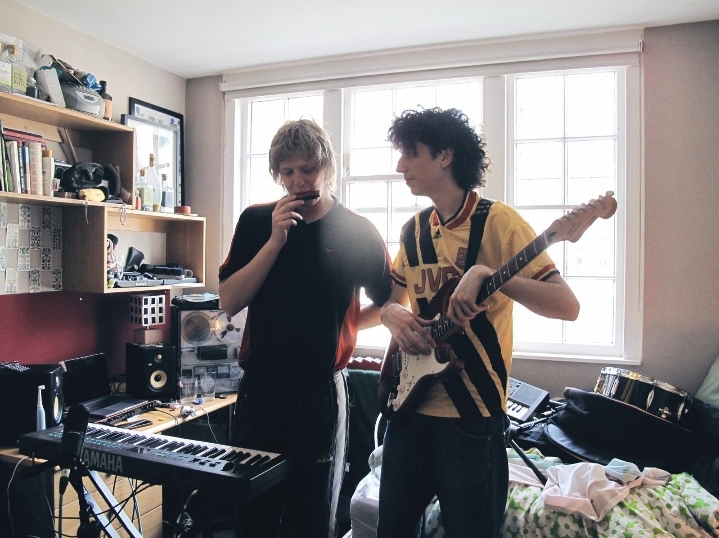
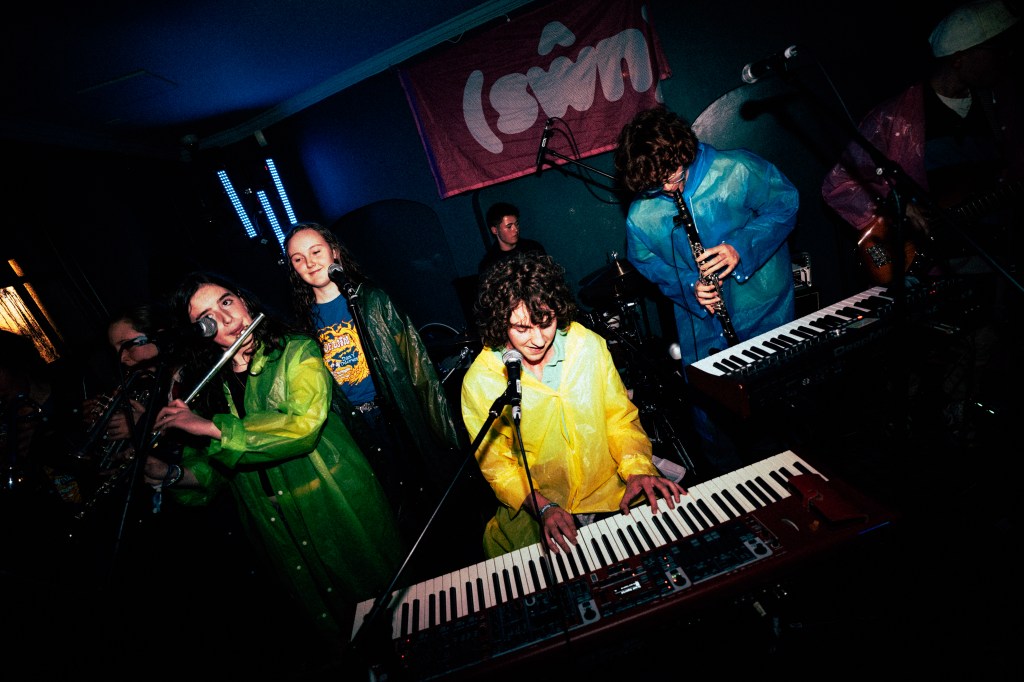
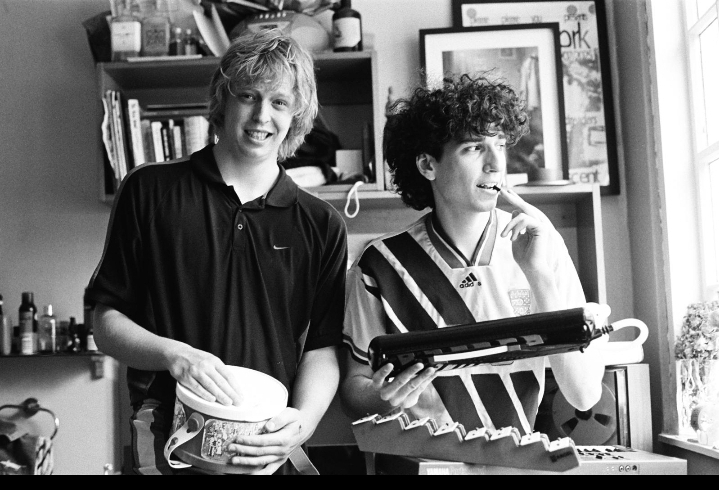
It is in this context that the lo-fi magic of Troutflies, recorded in bedrooms and adorned with layers of toy instruments, cheap melodica and anything else to hand, feels particularly vital. Troutflies are a duo formed of Reuben Pugh and Guy Godivala, who originally started recording together “for a laugh” on the side of their Sixth Form band, the York post-punk group Needlework. Live, the songs are reimagined by a rotating cast of musicians – among them Rowan Evans of Rowan and Friends and Tom Beer of Bull – who play along semi-improvisationally using an array of unexpected instruments and other sound-making objects in keeping with the spirit of the recordings. With this decidedly unique setup, the duo have seemingly hit on something perfect for the present moment, judging by the word-of-mouth excitement growing around the project. Their latest album ‘Wild Troutflies’ has just been released by label of the moment Private Regcords, with cult tape imprint Shooting Tzars doing an accompanying tape run. The record is awash with microphone hiss, compressor flutters, tape delayed guitars and all manner of implacable sounds. These details whirl around the core of each song, Reuben’s clangs of guitar and distinctive baritone, which drawls surreal, fragmentary lyrics. Among all of it, there is a sense of urgency, resourcefulness and possibility which feels just as inspiring as the distinct and original musical ideas playing out.
“I found this jagged music which I thought I could make.”
For Reuben, the project was initially distinguished from Needlework by its filtration through his songwriting. “Needlework was more collaborative”, he explains. “I guess musically [Troutflies] went along with what music I’d gotten into, self-recorded stuff and songwriters rather than groups. I found this jagged music which I thought I could make, rather than relying on other people… It was just kinda like, realising I could write songs and stuff, having more confidence and not thinking you have to play loads of chords to write a good song.” Smog, Daniel Johnston, Edwin R Stevens and David Berman are mentioned as some key reference points.
Guy’s input into the project is more responsive to Reuben’s initial ideas. This relationship is most apparent in the production of ‘The Dancing Years’. For this album, Reuben would spend a week writing each song and then present it to Guy to record and develop. “It was a song a week for eleven weeks”, Reuben remembers, Guy adding that overdubs and re-records were kept to a minimum. “We’d just get parts down [and] I did all the production and mixing in a day. I wasn’t thinking about it at all, I wanted it to sound like it was just recorded there.” While the pair collaborate throughout the process, Guy sees his role as, “Trying to lean into Reuben’s world… I get the bones of the song and I can be like, ‘How do I wanna dress this?’ It’s really fun”. At the same time, the idiosyncrasies of Reuben’s writing deepen the necessity of this approach. “Whenever I hear a song and think ‘I want Troutflies to go in slightly this direction’, I add it to this playlist… and then it’s kind of worthless because as soon as Reuben starts writing I’m like this will not apply.”
“We didn’t even think we’d ever do a gig!”
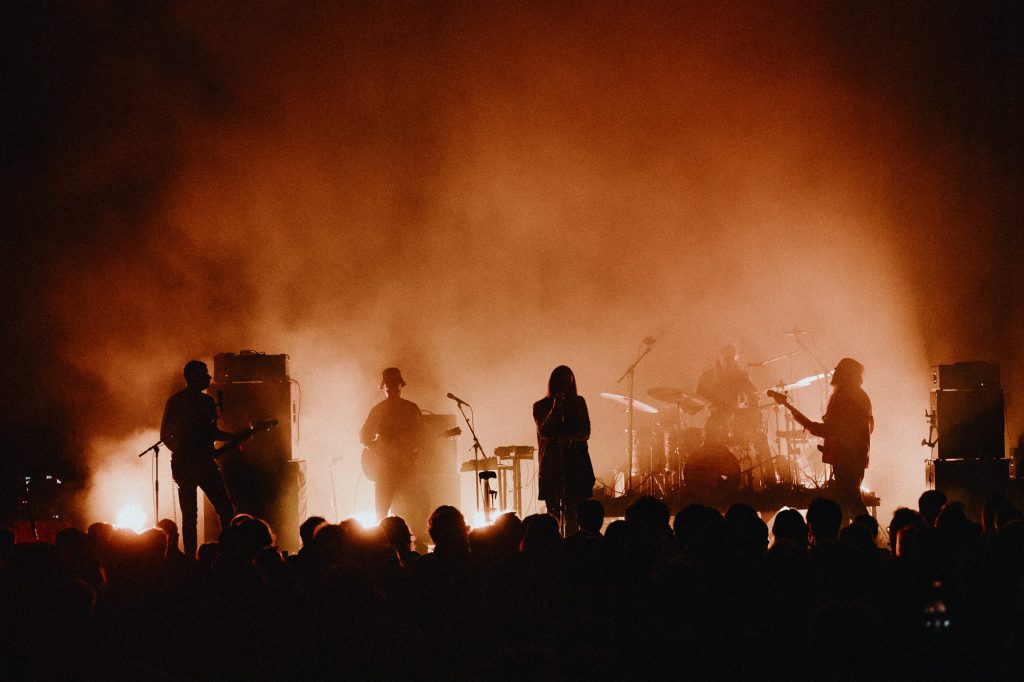
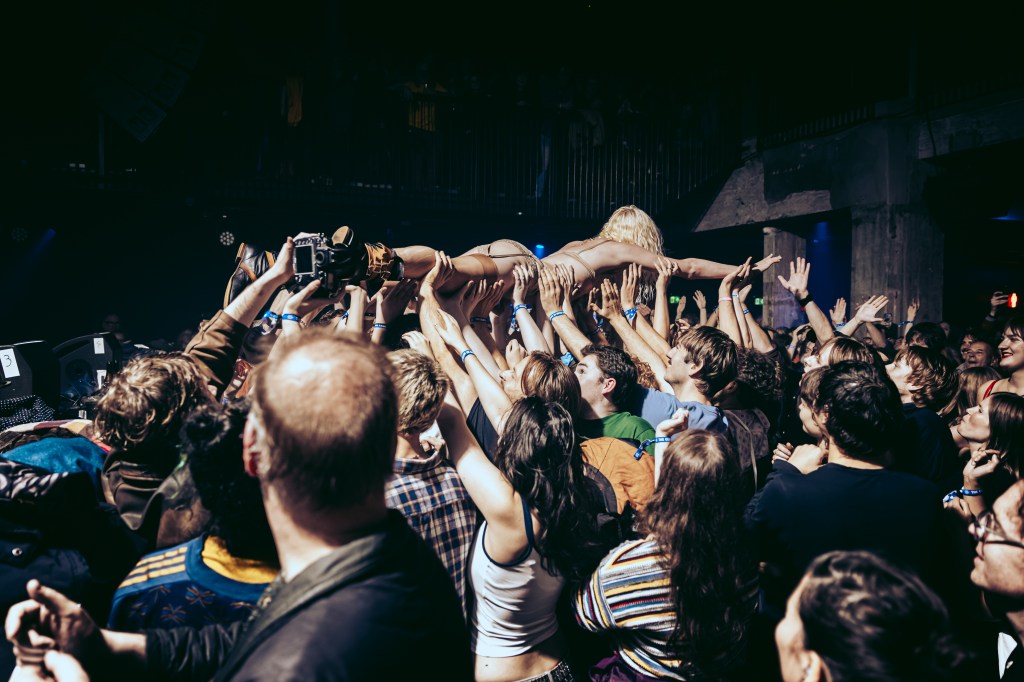
While the duo were pleased with their work, they did not necessarily expect it to reach much of an audience beyond their friends in York. But when Bathing Suits’ Alex Mulholland invited the band to play a show in Leeds, the set went down brilliantly. As Reuben recalls, “I’d only played in York like three or four times and I was like – I wasn’t hopeless about it, but I was like this is the sort of music that me and Guy like. And then we played in Leeds and it was sold out and like the best response ever.” This set a tone for shows up and down the country which have drawn more fans fascinated by this strange bedroom music which never strains to sound like anything but itself. There is also a sense of junkyard spectacle to a Troutflies show, given the rotating lineup and a setup that has variously included glockenspiel, melodica, toy bells and drums, a backing dancer and on one occasion “people playing, like, fidget spinner in the background”.
“We’ve always tried to make the most of what we have available,” explains Reuben. “So the first album was like, we used all the toys and stuff and melodicas because Guy just found them all in a drawer.”
“Yeah it’s all my grandma’s stuff”, Guy explains. “My grandma taught primary school music… I was like I’m just gonna put these in.”
This resourcefulness and embrace of the ephemeral, unprepared and untutored feels in part like a reaction against the conservatoire training which has shaped the provocations and rebellions of post-BCNR bands like The Orchestra (For Now) and Man/Woman/Chainsaw. But while the duo acknowledge there may have been some degree of conscious pushback against this style, as Guy points out, “The first album didn’t lend itself to any of the newer post-punk/Windmill scene. And we were not thinking we’d be part of that scene or anything.”
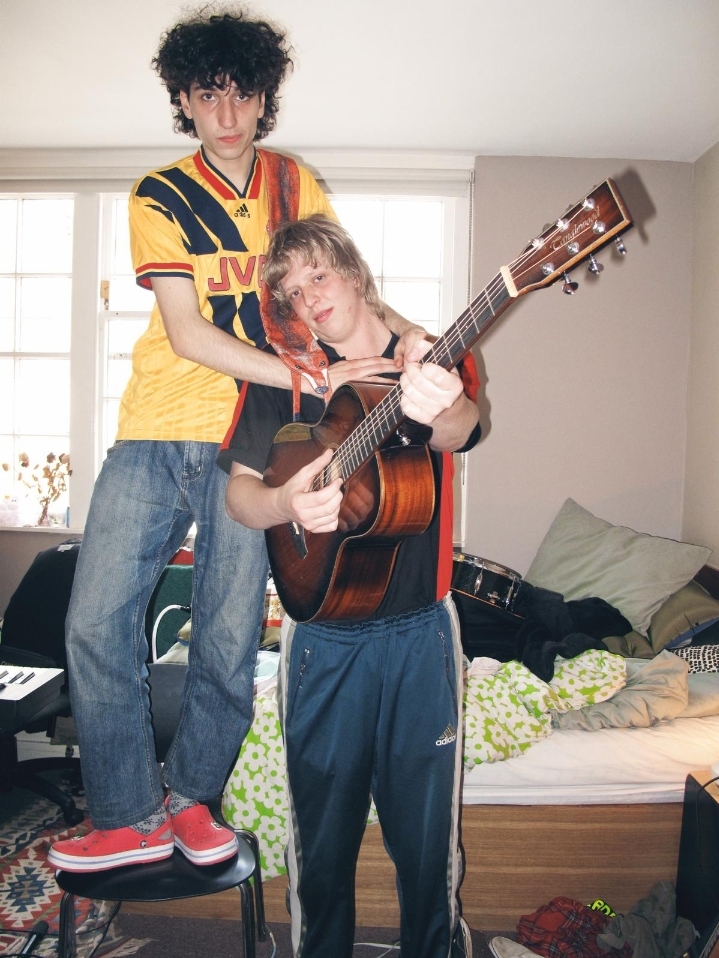
Reuben adds, “We didn’t even think we’d ever do a gig!”
Guy notes that he now goes to Guildhall, which he jokingly refers to as “one of those awful conservatoires”, explaining that this in itself was significant to ‘Wild Troutflies’ – on the band’s own terms, that is. “All the session musicians are from there. But it’ll be things like the recorder player [Mia Vojic], who you can hear on ‘Pugh’ – she does some amazing stuff on some of the songs, she’s classically trained, she’s got loads of recorders. And I kind of threw her back to be like, ‘Can you just improvise? And it made her uncomfortable, and you can hear that, which I like. And Shenara [McGuire] who plays the concertina. She plays violin as well but I played the awful violin [on the album] because she would have played it too well.”
“We just sort of bounce stuff across from each other.”
Unlike ‘The Dancing Years’, ‘Wild Troutflies’ was recorded across one week, Reuben coming down to London with all of the songs written on guitar. They mostly recorded in Guy’s halls bedroom, which he recalls having, “The worst insulation where it just got boiling hot no matter what. So that week, I never saw Reuben with a shirt on. We were just sweating constantly.” The mechanism of the album’s writing reflects the depth of understanding between Reuben and Guy, built from many years collaborating in various contexts. From the initial demo, as Reuben puts it, “We just sort of bounce stuff across from each other and it kind of works like that.”
On ‘Wild Troutflies’, this process was cemented by the use of a reel-to-reel to record the lead guitar. As Guy explains, “Because it’s not the best calibrated reel-to-reel, it slightly warps the timing…. and then it means that I can’t really touch the guitar part again.” From there, “I’ll add bass and synth and stuff but then [Reuben will] do a lot of the percussion and get like cool tape recordings he’s done, and we’ll get them in there. And we’ll really get it quite messy and then clean it up. It’s really fun.”
‘Wild Troutflies’ is out now in all its spiky low fidelity glory. This record distils the promise glimpsed at live shows and on ‘The Dancing Years’, the duo confident in their process and the additional elements they can bring in, while still experimenting on the fly. The sense of flux and immediacy is perhaps what is most exciting about this project, particularly in comparison to the sanitation expected even from independent bands aspiring to radio airplay or a place on Spotify’s ‘melomania’ playlist. Troutflies are among a new crop of acts re-embracing the homemade immediacy which has always been integral to the inspiring sense of accessibility and possibility in independent music.
As we spoke, the band were preparing for a brief run of dates at the end of September, the planned setlist containing almost nothing from ‘Wild Troutflies’. Their minds are already firmly on album three, Guy talking about working with the Guildhall orchestra on some of the songs. This aspiration perhaps best captures the fruitful tension they have established in relation to that sphere. For Guy, “Being able to have something grand and then pull it into this weird project would be so fun. It’s like a completely different world.” Diehard fans might fret at the band’s mention of “going away from the world of melodicas and xylophones”, but whatever comes next the essential principles of resourcefulness fused with necessity remain. And, as Reuben puts it, “It would be nice if we had access to like an orchestra and stuff… because we might never get that chance again. We’re not paying an orchestra, you know what I mean?”