Industrial techno and noise-rock collide on the Irish quartet’s purgative examination of our uneasy relationship with mental health.
“Father fled his son once he became sick, brother avoided brother, wife her husband, and thus the healthy fled from the ill.”
So goes the testimony of Marco Battagli, the chronicler of the Italian commune Rimini during the blight of the Black Death. Around a two day walk north sits Pugnello, a religious community that, legend boasts, was the only part of the country to emerge from the plague unscathed. To the citizens of Pugnello, the invisible degradation of the surrounding plains would have cleaved close to the phantasmic.
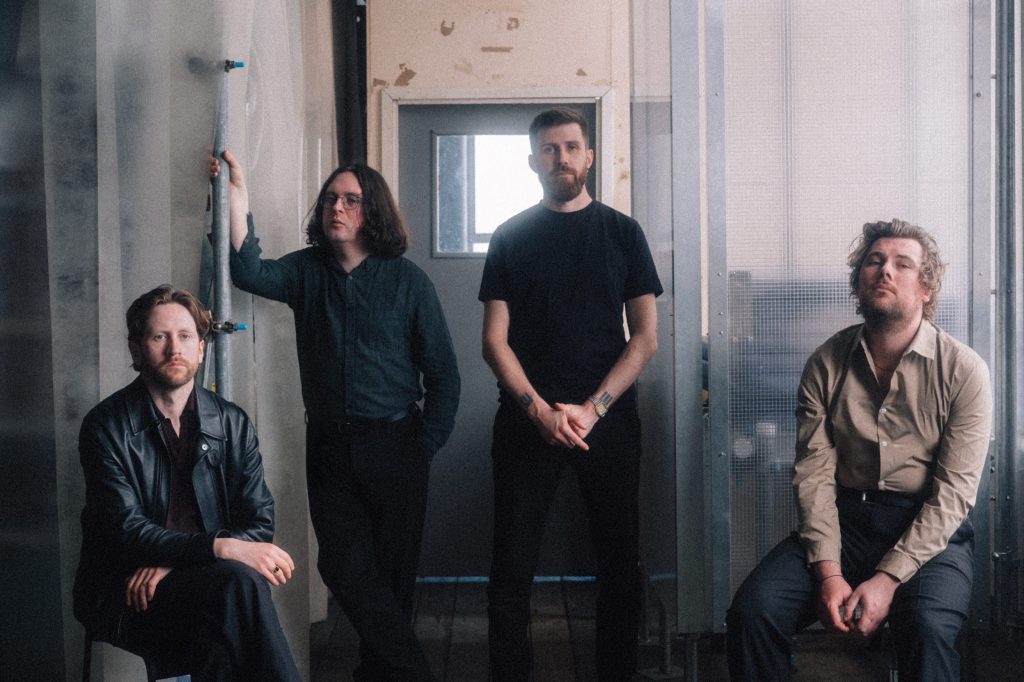
Swinging between the maelstrom and uneasy peace, Rimini and Pugnello’s contrasting plights can be easily mapped over Gilla Band’s fractured emotional topography. Lead vocalist and lyricist Dara Kiely’s sliced-up treatises have always carried a sense of aphasia, abandoning a family line’s worth of distorted selves as readily as they push their phrases to a premature end. Likewise, when trembling in moments of quiet or – more rarely – contentment, these silences are self-hating; pools of doubt that pledge a near-liturgical fealty to the threat, or maybe promise, of their transience.
But in the wake of Kiely’s schizophrenia diagnosis during its genesis, ‘Pugnello’ brings the personal detritus of wrestling with a mental illness into even sharper focus. Words still limp across sinuous connections, but their autobiography perforates further. ‘Placeholder’ and ‘The Angelus’ traverse a litany of “comfort vices” that harken back to Kiely’s childhood: a form of distraction, a transportation towards a semblance of innocence. Others tackle darker climes: ‘Alogia’ addresses the diagnosis head-on, stanzas stammering in tribute to the titular poverty of speech, a common product of a schizoaffective disorder.
The death of Kiely’s estranged father in 2022 also looms, though often dissociatively. “‘I’m so sorry for your loss’ / Well I should be more sad,” he chews on through ‘Jacobsons’, blowing a bubble of imposter confusion at this necessarily warped union with grief. Later, he builds up the courage to interrogate it directly. Imitating the dynamic of one of his favourite records – Neil Young’s ‘Trans’, a machine-guided communiqué with his disabled son – closer ‘At the Gallop’ is an imaginary motherboard lament from parent to child. Vocals embalmed in robotic effects, they tremor through the ghost in the circuit’s final pleas to “Make it stop / Make it numb / Make it good again.”
Words become weeping sores across ‘Pugnello,’ but each strand of neurosis is swollen by more than just verbiage. Approached with guitarist Alan Duggan’s recently acquired aptitude for power electronics-infected techno in his work as The Null Club, the LP disrupts the band’s post-punk hegemony with splints of drum machine and modular noise. Lead single ‘Giraffe’ bisects itself into these two distinct halves, freakishly stitched by the pulse of Adam Faulkner’s treated kit and insistent as a migraine. Meanwhile, ‘The Megazord’’s disfigured EBM radiates throughout the entire spine of the track, as does the martial techno strangulation pulled tight on ‘Crisp Pop’ – the closest the foursome has gotten to recreating the bleak industrial wasteland of Blawan’s original ‘Why They Hide Their Bodies Under My Garage.’ The aforementioned ‘Jacobsons’ might be the LP’s crowning moment. No less than an onslaught, synth punk has likely never been so bluntly primal.
Still, in sickness or in health, ‘Pugnello’ retains a sort of assassinated beauty. There may be no immediate comfort in its disturbances, but catharsis undoubtedly reveals itself through the distortion, the word ultimately bound to scathed flesh as it reaches for conclusions that could finally, perhaps, be their own.