The duo’s comeback is suffused with post-apocalyptic premonition and intricate detail.
If there’s one thing life has taught us in more recent times, it’s to do the very opposite of what the worst people tell you to do. In 2020, Spotify boss Daniel Ek argued that ‘continuous fan engagement’ was the essential means of surviving as an artist: “It’s about the storytelling around the album, keeping a continuous dialogue with your fans… you can’t record music once every three to four years and think that’s going to be enough.”
‘Inferno’ is Boards of Canada’s first album in thirteen years. The years since their last release, ‘Tomorrow’s Harvest’, have been total radio silence: no interviews, no shows. Then, in early April, mysterious parcels containing VHS tapes appeared on the doorsteps of unsuspecting fans, hinting at something new.
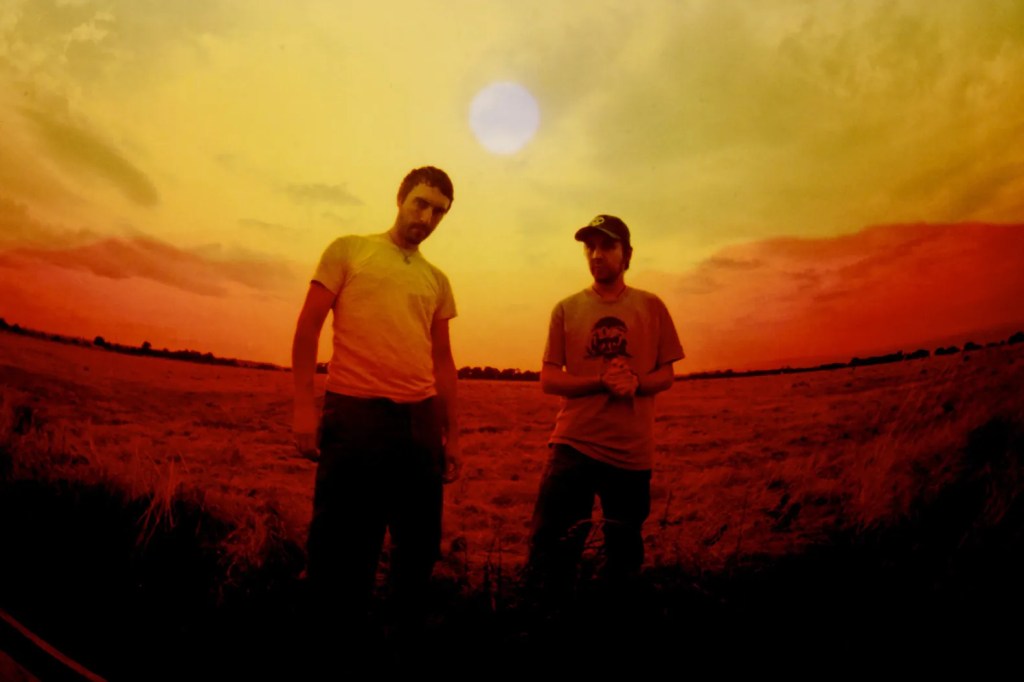
For the unacquainted, Boards of Canada are two Scottish-born brothers: Michael Sandison and Marcus Eoin. Their music belongs to an esoteric world of code, conspiracies, mysticism, science, maths and occultism. Off-kilter IDM grooves, made up of degraded tape loops, unsyncopated rhythms and vintage synthesisers, serve as vehicles for these ideas, which themselves cohere occasionally as heavily processed vocal samples. The outcome is music that feels somehow intimate, impenetrable, sparse and vast, all at once.
The album’s lead single ‘Prophecy at 1420’ offers the perfect launch pad into the brothers’ latest and perhaps last venture through deep time and space. The track’s dark-wave guitars sound like the beams of a ray-gun being blasted by an intergalactic space creature, before spliced fragments of a lecture on Consciousness by Seyyed Hossein Nasr, a leading voice in Islamic science and spirituality enter the mix: “Nothingness. I am the truth. Extinction”… and we’re off.
As demonstrated by the clues and codes of the promotional campaigns that reveal subliminal messages to the track names, there is always a sense of deliberation and craft to the work of Boards of Canada. On ‘Inferno’, this attention to detail guides its imposing eighteen-track length. ‘Memory Death’, which comes in at the album’s midway point, the decisive part of this journey. Here, death, a recurring theme on the album, makes its presence known in full, as swarms of flies and ghostly reverberations of what sounds like the last breaths being drawn out of a body play out. What sounds like a life-support machine beeps away in the background, an audio equivocation of life’s final moments.
‘Word Becomes Flesh’ follows. It begins with overpowering lounge jazz synths that scream Overlook Hotel. It carries a sense of limbo, as if we were passing through, and now find ourselves in a spiritual corridor awaiting our fate…all before the audio from an educational video on embryo evolution plays out. As if to say: we’re back at the start again.
In a rare interview in the build-up to ‘Tomorrow’s Harvest’, the pair spoke about “collapse” being the central idea of the album, in part fuelled by their own growing nihilism. The album captured this sense of collapse with an unsettling atmosphere which – much like its artwork’s depiction of a post-industrial wasteland overlooking the San Francisco skyline – hinted at something on the horizon. The songs on the album explored dystopia, climate change and a feeling of impending doom, It felt true to the time, soundtracking a growing realisation that there was little in the real future for humanity to look forward to.
‘Inferno’ seems to call into being the collapse of civilisation which loomed over ‘Tomorrow’s Harvest’. As in Dante’s narrative poem, to which the title surely alludes, the album is situated within the hellfire, which they see in our world today. Where Virgil was Dante’s guide, we have Boards of Canada bringing us through our own cores of hell, where sin, heresy, violence and Christian guilt are still rife.
There’s no getting away from the fact that ‘Inferno’ is a real bleak ride. Boards of Canada seem preoccupied with the idea of destruction’s aftermath. So much of the album feels like surveying the scenes of the scorched earth through a window of a high-speed train. Occasional moments of respite reminding us that there can still be beauty amidst destruction, ‘You Retreat In Time And Space’, in particular, feeling like one such moment of salvation. All this comes before we’re steered ever closer to the end, which arrives with ‘I Saw Through Platonia’. This, the final track, an epic crescendo where a malfunctioning computer and a human heartbeat are in unison, only for everything to suddenly sto…
‘Inferno’ is hardly any fun; it is a complex, jarring, psychogeographic journey through end times, each track a stop en route to oblivion. A feeling of finality runs the whole way through, which is to say ‘Inferno’ is an album preoccupied with endings: the end of human life, the end of the world, and what lies on the other side of these endings – new beginnings, rebirth, transcendence.
This album, like ‘Tomorrow’s Harvest’, will divide opinion, not least because there’s no easy way in. To experience it in its full glory requires patience – a patience that, in an age of distraction, almost seems itself like an act of resistance. And this is what ‘Inferno’ might just be; a call to resist the reels and sit with the discomfort of a world descending further into chaos. In that sense, the most hopeful interpretation of this album is of forewarning: the end is nigh, but we’re not there yet. Starting from an acceptance of the crisis of the present moment, Boards of Canada search through the rubble and ruin and seek out what might still be salvageable.