
As the band release new album ‘EXPO’, we catch up to talk creativity, detail and working over WhatsApp.
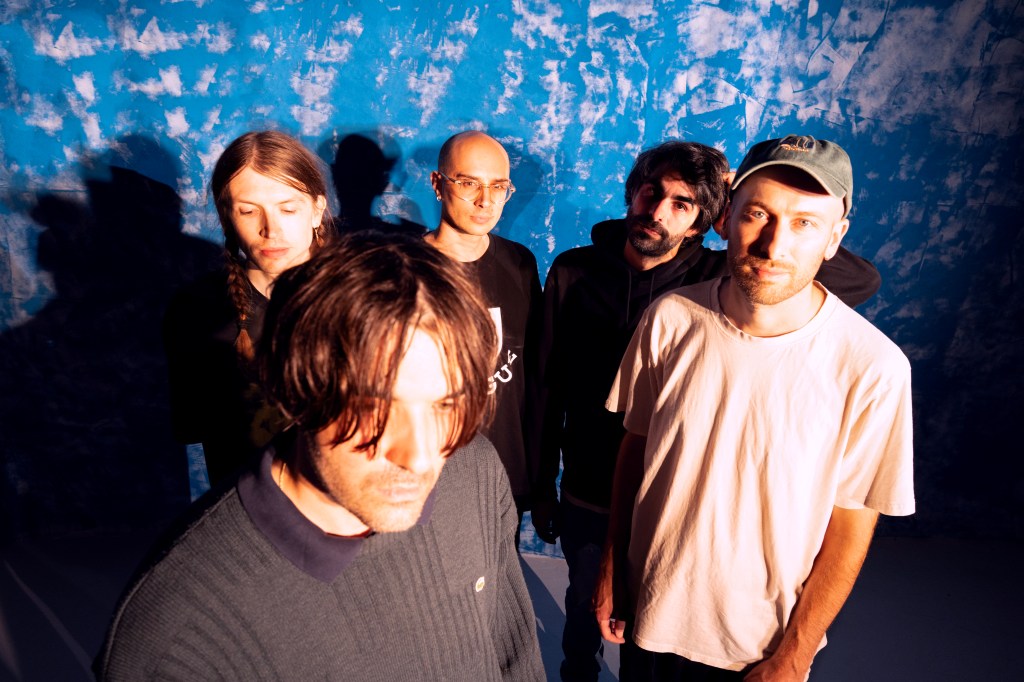
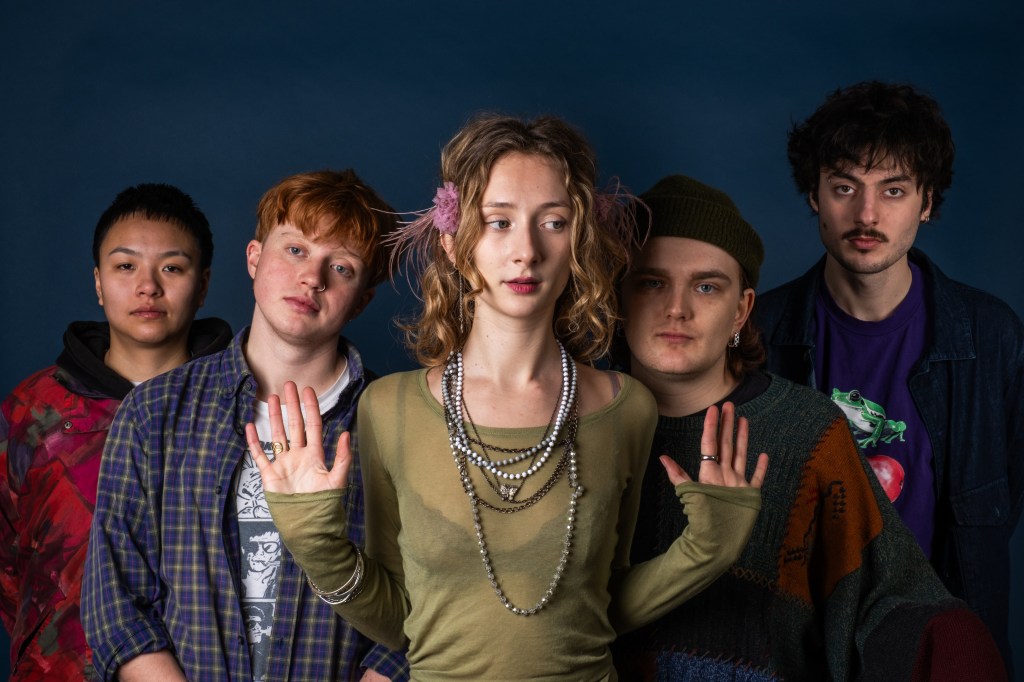
For over a decade, Ulrika Spacek, across a series of consistently boundary-pushing releases, have been marking out a uniquely incisive brand of experimental art-rock. They are the kind of cult band who, once you discover them, you hold closer to your heart than most (and they make you feel cooler than most too). Spacek-trademarks – jangling guitar networks, meticulous production, unconventional song structures – reach new heights on latest album ‘EXPO’, released last week via Full Time Hobby. A foray into a more digital era, laptops, sample banks and something called a ‘Culture Vulture’ are among the many new toys and tricks helping Ulrika Spacek stay inspired and stay playful, while still remaining unequivocally themselves.
And so, sitting down with Rhys, Joe and Sy backstage at Rough Trade East, we talk about all things ‘EXPO’, the eye-watering Whatsapp group-chats that conceived it, and how, try as they might, they still can’t write a song without guitars.
Your album came out today! Congratulations! What do you do on an album release day?
Rhys: It’s been very hectic, weirdly. More hectic than a normal day for us. We’re playing a show. We’re doing some signings. We’re doing some interviews. We haven’t made time to have a little hug together. Maybe that comes after. It’s essentially been a day of celebration.
Joe: It’s hard to find time to even sit down and address it. But It’s good to be busy.
Rhys: I left the house this morning and was like “it’s release day”, but it was so drizzly. You’d think they’d bring the sun out. After two years of work, you do get a bit of a dopamine rush on release day. Not that it’s about this, but you do get a bit of validation that makes you feel like, “Oh, there are people that notice what you’re doing”. I think many artists can say this, but ‘the crushing low of the day after, or two days after’? You get that with other artforms. If you work in fashion, and you make a collection, and you spend all your time on it, and then the week after, you can’t get out of bed. So we’re enjoying today, full well knowing that the next week, sometimes, you can feel a bit…
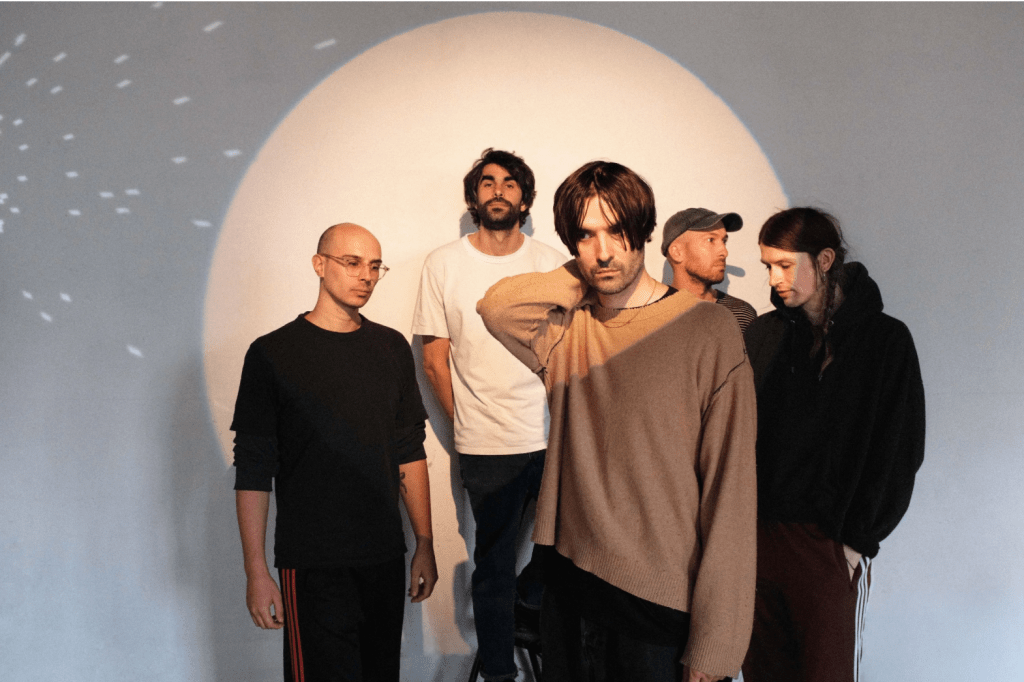
Let’s talk about the album ‘EXPO’. The thing that stands out mostly for me, in contrast to your previous works, is that there are songs with barely any guitars on them. Some keyboards. Some bloops. How did this come to be?
Rhys: I don’t think it’s a cynical thing of, ‘you need to change everything, change up your sound’. It’s more that the only way you can write is if you find something that’s inspiring to you. At the time of starting EXPO, I think we really weren’t feeling that inspired with things you play on guitar. I would say that changed a little bit. I can’t speak for everyone, but I would say that I’m much more into guitar right now after that album. You’ve just got to find new machines to be a child again, and feel naive, and sadly, for guitar, at that time it wasn’t for us. But there’s loads of guitar on the record.
It definitely still feels like an Ulrika Spacek album.
Joe: We tried to do a track with no guitars, and inevitably, some got added. We thought maybe this would be it.
Rhys: You saved it with those guitars, Tom. On ‘Build a Box (And Break It)’.
Joe: And it ended up being the loudest bit of the song.
We were wondering if there was any exciting new gear or equipment you used on this record?
Rhys: 404 samplers. They were a big tool. Not necessarily just for sampling, but using it for processing.
Joe: It colours the sound in quite a cool way.
Rhys: You have to include the laptop. It’s one of the first times where the laptop is really an instrument, on this record. Syd works full time as a producer, but all of us have improved as individual producers as well. It’s a strange record in that it’s the one closest, in my heart, to when I was 14. In the early 2000s, a lot of rock bands were inspired by electronic music, like Warp records and stuff. And when you’re really young, you can’t really comprehend how a rock band could introduce electronics and samplers and stuff. And on this record, it was that time in our life where we were able to use samplers and computers in an interesting way.
Syd: Also, if it’s a geek question, most of the drum sounds come from the Culture Vulture. Which we haven’t used before, and it’s a big part of the sound.
Culture Vulture is such a great name. Do you have any other cool-sounding gear in your studio.
Rhys: It’s a pretty common plug-in, but the ‘Decapitor’.
Syd: It’s based off the Culture Vulture actually.
Our favourite part of the record is when ‘Weight and Measures’ hits. For me, that song is one of the most ‘out there’ experimental tracks you’ve ever done. Tell us about it.
Joe: This was an interesting one to record. We all tried to take it in different directions. There was a little bit of tension there sometimes – can we go with this sound? No, we have to go with the original, digital-sounding sort of thing. And eventually, we settled on something we’re all happy with. But it definitely tested the edges of our creativity, I would say.
Syd: We started wanting it to be more sample based. Half of us were like, let’s do the exact opposite, re-record everything with synthesizers, and we ended up even having real strings playing whatever was sampled. And it doesn’t feel like a cop out or a compromise.
Rhys: We’ve always been out of sync with modern culture. We’ve always been on our own trajectory, as every artist should be. In recent years, at least personally, I’ve been inspired by the post-dubstep UK sound of James Blake, Mount Kimbie, stuff like that. This song, at its heart, has that. Of course it goes into other places, but that’s where it stems.
You touched on it there, but what fascinates me about watching guys perform, even listening to your music, is how many details there are in your music. I’ve always been curious how you build these intricate songs together as a group? Even there you were talking about all the tensions and discussions and decisions to be made.
Rhys: And how do we still survive and not break up!
Syd: We very much all feel like we can all step in whenever we feel like it, when something inspires us. If four of us are stuck on something, and one of us has got a bit of inspiration for it, then that person might put a little thing onto it, and that might inspire someone else to be like, “Oh I actually wanna do this”. Sometimes it’s two people that do most of the song. And other times everyone’s chiseling at it. And if you don’t have anything to say, you don’t say anything.
Rhys: Five brains is better than one.
That’s a fine balance. If people are willing to step back, there’s no big egos, they just want the songs to sound really good…
Rhys: We’re friends as well! That’s a big thing.
Syd: I love what everyone is else is bringing to the table as well. I can’t wait to hear what that person is going to do. I can’t hear it yet, but I know it’s going to come from someone, and I think we all kind of rely on each other in certain ways. For loads of different things. Not just writing parts, but sometimes helping the song go a certain way.
Rhys: Part of the fun is putting two ideas together that it feels like you can’t put together. Then it’s changing tempo, changing pitch, sometimes changing time signature. And when you have two ideas that don’t go together, and somehow you make them work together, you know you’re in interesting territory. Rather than five people in the room, all jamming along, and everything sounds like it should do.
Syd: There’s one song we did that way – ‘Showroom Poetry’.
Rhys: That’s why it feels so pleasing.
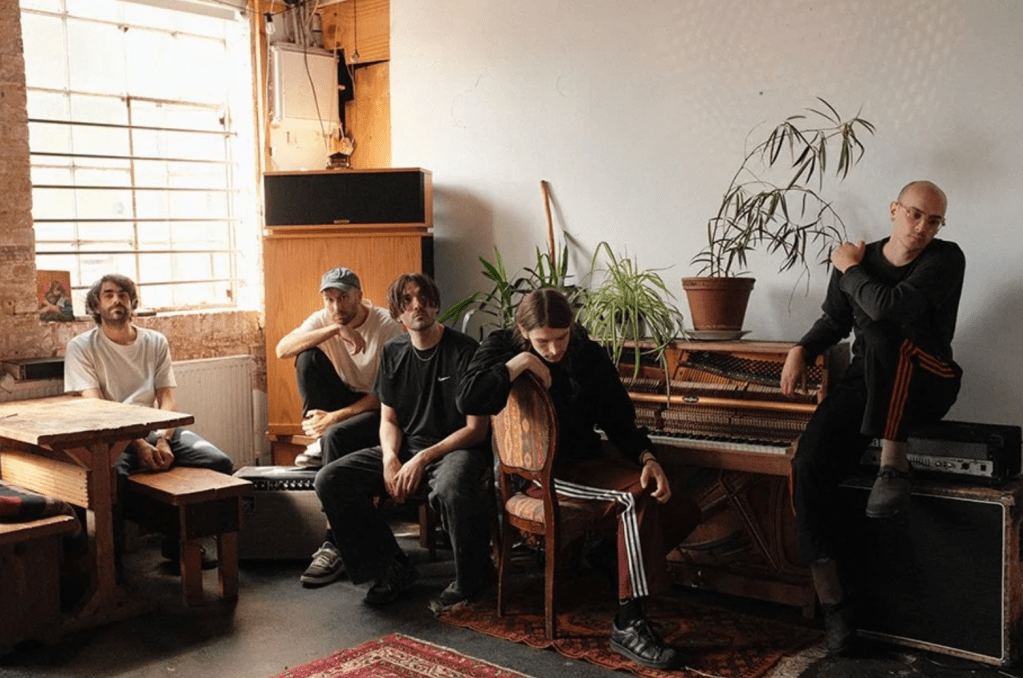
So you live in Sweden, Rhys, and the rest of you live in London or thereabouts. It must be a struggle that you can’t get together that often. How does the band work on a logistical level?
Rhys: WhatsApp. We have a WhatsApp thread that is popping off. It would make your eyes burn.
Joe: You talked about us being a details band…
So you discuss all the details for the songs in WhatsApp?
Joe: Sometimes we have to take it into separate one on one chats!
Rhys: If you miss your place, and it’s 20 minutes, you’ll look and it’ll be like 45 messages
Joe: We need stuff in the diary. Then we get together, we meet in person, we have rehearsals, we sort stuff out. And in those little gaps in between that’s when we message and share things in Dropbox.
Didn’t you record in Sweden as well?
Rhys: Yeah! We do a lot of recording on our own. People don’t just rush to add their part for the sake of being involved. Everyone has the capability to record by themselves and think about what they want to contribute. Sometimes that can be really tasteful. A little bleep, or a little blob. We did also get together in Sweden in the height of winter.
Joe: We feel very productive when we’re all together. When we’re at home doing our stuff, we take our time, really consider everything. But when we have time together, three days, we make so much progress, and things really take shape.
Syd: And that’s when we record drums. And drums are quite a big part of this album. So once we got the drums in the place, it does feel like everything, not writes itself, but you’ve got a better idea of where to take things.
Rhys: Another point, it’s not only electronic elements that Callum adds with drum loops, but when you use saturation on drums, it adds a harmonic, and even when you haven’t written the part, even on the snare and the kick, you hear the melody. That’s so true about this album, distorted drums have guided the melody.
Joe: Callum contributed a lot by making a sound bank of different beats, before they were songs. It was so much more musical this time, he used sub bass and saturation. It would really inform the key of the song.
Rhys: On this record we had a sample bank. It felt fresh to us, but we’ve since found out that Portishead did it on their second album. We’re not the first band to do that. It’s very hard to sit down and be like, “I’m going to write a song”. It’s very hard. But when you’ve got a bank to work with, you’re holding onto the moments of excitement: “I wonder if that guitar line with this bass line works”. And there’s always a moment when you’re lining it up, before you hit space bar, there’s a little anticipation where you’re like, “this could be amazing”. A lot of the time it’s not. But the moment when you’re like, “this is so trippy”, and it sounds so high brow and more thought out than it is, cause really it’s taking a chance of putting two things together.
Some people like to play video games, I think you get dopamine hits from playing with music. Music should feel like play. It’s very easy, especially when you’re three albums in. There’s been times in my life when I’m just doing music full time, and you wake up in the morning, and you work for five hours and nothing comes, and you feel like a piece of shit, you feel like a fraud. Music should be something like, “I wonder if I just do this…oh this sounds good”.
As you’ve been a band for a decade now, are there any bucket list items you still want to tick off
Joe: A big thing for me, which we ticked off in 2018, was touring America. A big thing for me growing up as a teenager, wanting to be in a band, that was top of the list. Now, it’s just, Japan!
 Hard Of Hearing Magazine