
With just one single out and a slew of support slots with Geese, Dove Ellis justifies the hype and then some at the Horse Hospital.

Dove Ellis is news. Or at least news to me, when the headline arrived at my desk a couple of weeks ago. I woke up one morning and I was living in the world of Dove, as footage of him performing in the round occupied my FYP. Who was this guy, who, before even playing a headline show or releasing a single, had apparently bagged the opening slot for Geese on their entire North American tour? Somebody, somewhere, clearly believes in Dove – to an extraordinary extent. With this amount of hype, I had a natural scepticism, which, at his first headline show, was immediately demolished by a crashing wave of post-folk brilliance. His sold out performance at The Horse Hospital was an overwhelming experience, the kind that leaves a lump in your throat and sweat on your brow. Each song was followed by a moment of awestruck silence, and that vacuum instantly filled by an explosion of rapturous applause. I saw the literal meaning of the usually figurative term ‘breathtaking’ play out in real time. Ellis’ soaring, Jeff Buckley-imbibing vocals, matched with a masterful combination of folk ambience and powerful rock crashes, is irresistible.
I thought he was a sound technician when he first took the stage. He looked like any other person in the room: Docs, Levi 501s, a navy blue mechanic’s jacket, a straight-ahead haircut. He moved nervously on stage, as if not quite believing he was supposed to be there. He opens his mouth to sing, and the audience’s mouths are left agape in response. His vocals occupy a space of poetic delicacy, a lilting, vibrato-infused falsetto, which is reminiscent of Thom Yorke, with touches of Tiny Tim. Despite his unassuming presentation, Ellis’ stage presence drips with unaffected emotion: he buries the body of the guitar into his torso, his legs positioned in a crouch start, as if someone told him “on your marks” before he came on stage. Once the first chorus arrives, his voice elevates to a perfectly pitched cry that never devolves into a shout, and surprisingly made me think of Sam Fender. If Dove Ellis can invoke even one percent of the latter’s populism, he will go far.
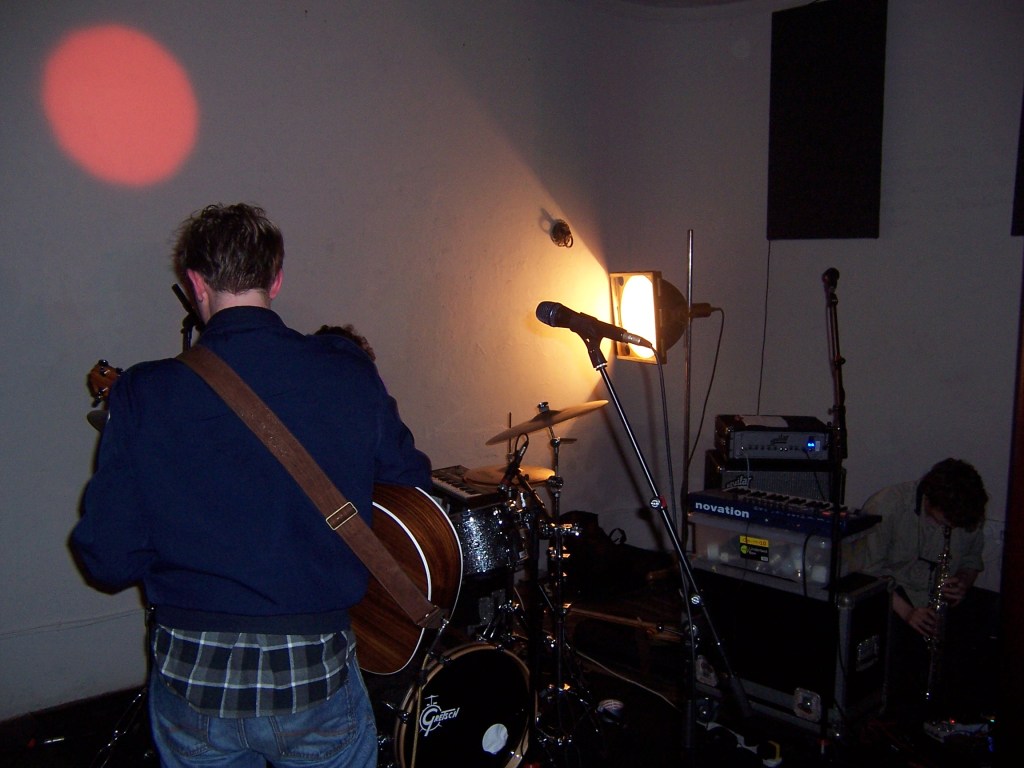
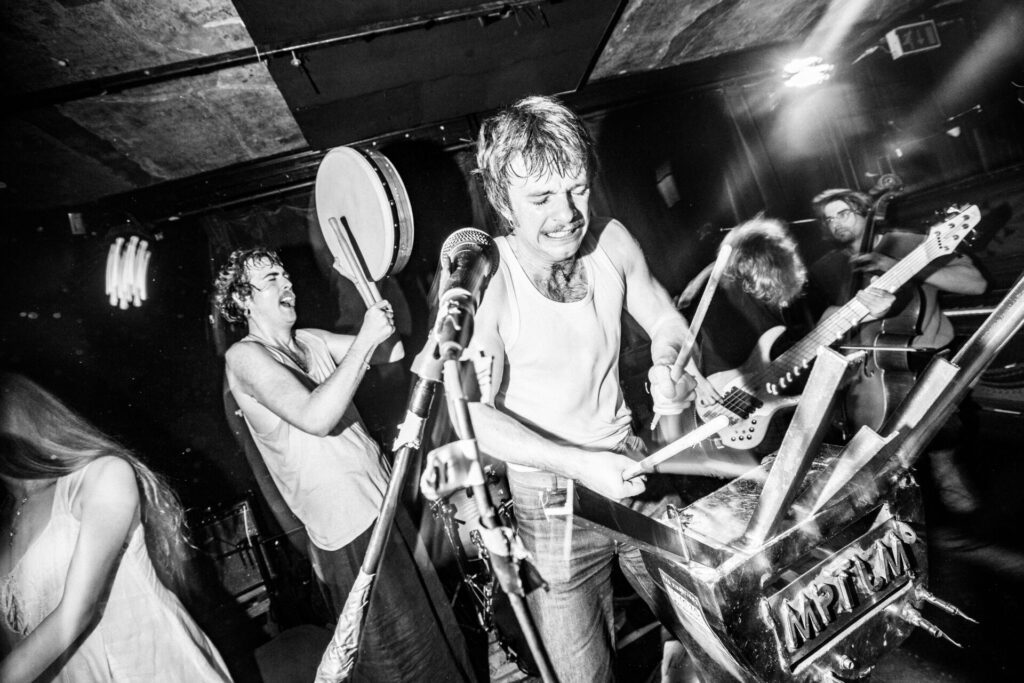
His instrumental backing brings new meaning to the term ‘power trio’. Unlike many other experimental instrumentalists who are surprisingly formulaic in their application of the term, they never repeat an idea twice just for the sake of it. At intervals in the setlist, the drummer gently taps bells hung from a string, triggers samples on his Akai MPC, and intermittently surging onto his drum kit with dramatic crashes. The drumming brings an element of slowcore to the music, often using a driving beat switch which invokes in particular the second half of ‘Sunglasses’ by Black Country New Road, but also wouldn’t sound out of place on a Duster record. Completing the trio is a keyboardist, alto saxophonist and backing vocalist. He too refuses to rinse and repeat: a standout moment was a sax freakout during which he processed the sound through a myriad of effects, creating a kind of free-jazz cacophony.
The standout performance of the night is one of the standout songs of 2025. ‘To The Sandals’ is a chamber folk masterstroke, a work of genuine pop poetry, which functions as a vehicle for Ellis’ wonderfully emotive lyricism, as specific as it is abstract. It might be a cliche to compare an Irish singer-songwriter to Yeats, but Ellis’s words are so brimming with Romantic, sensual imagery (Each head in each fog town / Thought must I really lust? / Or knelt at the furless pulpit / The harrying, carrion / Nightmare) that only comparisons to the greats of Irish Romanticism are justified. Like all great pop songs, however, it has something better than lyrics: enough hooks to hang a thousand coats – from the call-and-response descending motif of the alto sax to the earworm ‘harrying, carrion nightmare’ refrain. Another highlight was a rendition of ‘April The 14th’ by Gillian Welch, whom Ellis cites as “the greatest songwriter of all time”.
We are finally seeing the emergence of bands influenced by Black Country New Road who are able to channel their influence without ripping it off. Like his friends Westside Cowboy, with whom he has appeared on stage previously, Ellis brings the chiming, ambient Americana guitar style of BCNR and their multi-suite ambition, whilst fusing it with distinctive voice, musically, lyrically and instrumentally. Prior to the closing track, he mumbled modestly that this was his first headline show. After it, he rushed off the stage with his head lowered, out of shyness it seemed, rather than arrogance. This degree of modesty would be admirable for anyone so obviously on the precipice of success. It seems downright impossible for someone with such incalculable talent. Ellis pulls it off.
 Hard Of Hearing Magazine