The Brooklyn band’s latest record epitomizes their mastery of the space between self-assurance and intimate vulnerability.

‘Double Infinity’ does not begin so much as it shimmers into existence, like a memory resurfacing from somewhere between dreaming and waking. Big Thief drop us straight into a liminal space, where sound becomes a kind of language between inner and outer worlds: grainy and golden, emotional yet weightless, like flipping through an old photo album in a dream. Adrienne Lenker’s voice arrives not with clarity, but with feeling. Her lyrics are elliptical, bordering on abstract, as if overheard from another room in another life. The record drifts between nostalgia and playfulness, its earthy textures and tape-warped haze evoking earlier forms of indie folk, while unpredictable song structures and whimsical lyrics lend it a raw, exploratory charm. Throughout, the body becomes the bridge between past and present. You don’t know where you’re going yet, but the light is soft, the air is familiar, and you follow.
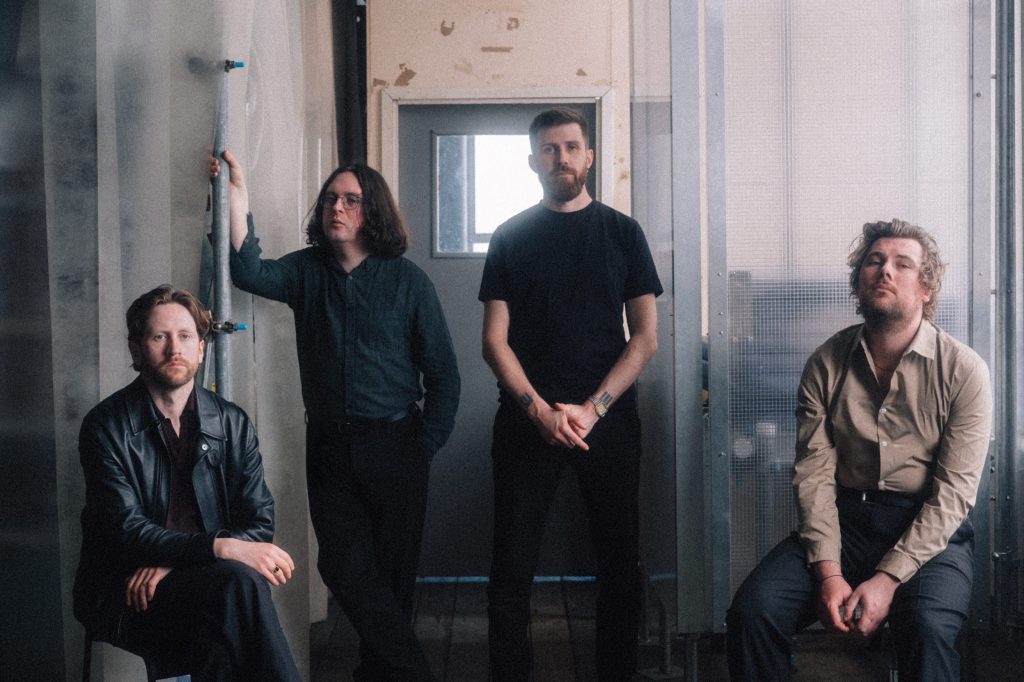
Big Thief, formed in Brooklyn, New York ten years ago, are centred around core members Adrienne Lenker (vocals, guitar), Buck Meek (guitar), and James Krivchenia (drums). For their sixth studio album, they were joined at The Power Station in New York City in January by Joshua Crumbly on bass, Mikey Buishas on keys, percussionists Mikel Patrick Avery, Jon Nellen, and Caleb Michel, guitarist Adam Brisbin, and background vocalists Hannah Cohen, June McDoom, and Alena Spanger. ‘Double Infinity’ is the product of a deeply collaborative and improvisational process. Across the nine tracks produced by Dom Monks, the band explores themes of nostalgia and existentialism with a sound that is warm, and vulnerable, infused throughout with the spirit of collective creation and discovery.
‘Double Infinity’ is intimate and soft, with lyrics that are honest and raw, yet it never feels fragile. The words land with the gentleness of handwritten pages from a diary but linger with the permanence of ink scratched into skin. “How can beauty that is living be anything but true?”, Lenker asks on the opening track, ‘Incomprehensible’, a line that continues to echo long after the track has ended. The song blends the rock textures of guitar feedback and hypnotic percussion with the confessional storytelling of folk and a subtle electronic groove that lends it a dreamy, psychedelic sheen. The words cut through, Lenker’s vocals stripped-back and bare, while the instrumentation gleams with melodic complexity.
Big Thief create a musical translation of a deeply personal, often vulnerable, and always honest inner world. The lines, “Only ever half home I’m / Only ever half alone / With my subconscious” cut through the upbeat guitar melody on ‘Words’. Their emotional weight contrasts with the lightness of the strumming, yet what might seem like a contradiction gives the track its emotional resonance. There is a delicacy in Lenker’s reflections on the limits of language, a quiet frustration in how words can fall short. Her subconscious holds the truth, while “words won’t make it right.” The gritty guitar textures of the instrumental bridge, paired with tight percussion, translate that tension into something tangible, an emotional undercurrent that pulses just beneath the track’s surface.
The confessional nature of Lenker’s lyrics is heightened by the production throughout the record. ‘Los Angeles’, a song that looks back on memories with an old lover, opens with the soft sound of laughter, slightly dissonant but unmistakably intentional. The track gradually dissolves into stillness, giving way to the gentle piano that surfaces beneath the rhythmic percussion on ‘All Night All Day’, a song that embraces a love that is current, embodied, and unashamed. “All night, all day / I could go down on you”. Placed back-to-back, these two tracks deepen the album’s existential atmosphere, capturing the fluid passing of time through inner and outer worlds. The faded, dragging percussion on ‘Los Angeles’ mirrors memory slipping into a whisper, while the floating groove of ‘All Night All Day’ evokes love as something physical and real, where vulnerability overrides shame. These two depictions of love across time converge on ‘Happy With You’, where the single lyric “I’m happy with you / Why do I need to explain myself? / Poison shame” is repeated like an incantation, each line echoing with tenderness.
There is a constant tension throughout ‘Double Infinity’ between the intimacy of the inner world and our grounding in our own bodies. The instrumentals often feel hazy and unfocused, like a memory just out of reach, yet the lyrics cut through with striking clarity. Even when exploring abstract concepts like time, love, and fear, the songwriting remains rooted in tangible imagery: fire, skin, the contours of a lover’s face. “There is no face that isn’t in your face” Lenker sings in a blurred whisper on ‘No Fear’. These anchoring details keep the songs from drifting beyond comprehension. On ‘Grandmother’, featuring Laraaji on zither and harmonising vocals, the melody floats into something almost ethereal, but the steady percussion keeps it grounded, and Lenker’s lyrics invigorate the track with a cathartic presence. “It’s alright, everything that happened, happened.”
The instrumental textures sparkle on the title track, ‘Double Infinity’. Lenker lifts her pitch into an unpolished hum, delicate and raw. The percussion is as steady as a heartbeat, and the guitar melody holds a calming rhythm, as if guided more by instinct than intention. There is a softness in the melody that the lyrics ignite with emotional chaos. “The trees on fire, the rivers flood / And all the banks are soaked in blood” is sung like a gentle lullaby, a contradiction that sends a shiver down the spine. ‘Double Infinity’ reaches into a space between what is forming and what is fading, desire and regret, and in that in-between, it quietly asks if love might be the only thing that endures.
“How could I have known / In that moment / What we’d turn into?” Lenker asks on the closing track. It is a quiet resolution to the record’s central tension: time passes, feelings shift, love fades, yet the body remains, present and still, holding it all. ‘Double Infinity’ dwells in this liminal space, where the inner world of thought and memory brushes up against the outer world of bodies and landscapes. Where the earthly grit of guitar strings meets the ethereal shimmer of zither or synth. Words and sounds trade off as primary messengers. At times, language falters, and it is the tone, the texture, the hum that carries the truth forward. The production process of simultaneous improvisation reveals itself not only in its layered instrumentation, but also in its willingness to sit with contradictions: between clarity and abstraction, form and dissolution, noise and silence. And maybe that is where its beauty lives, in the space between.