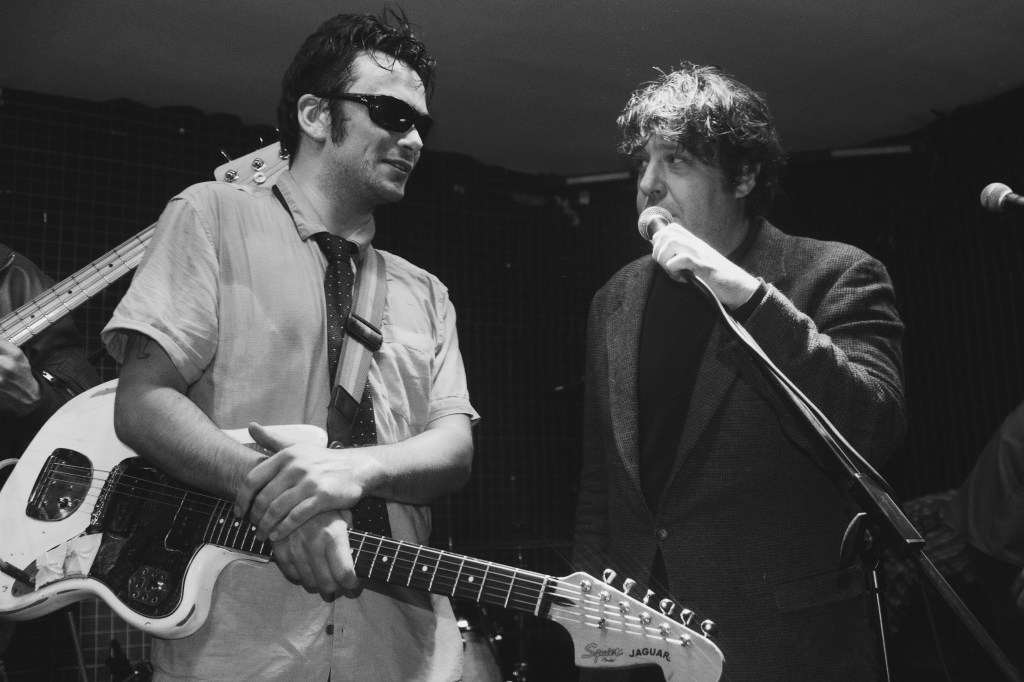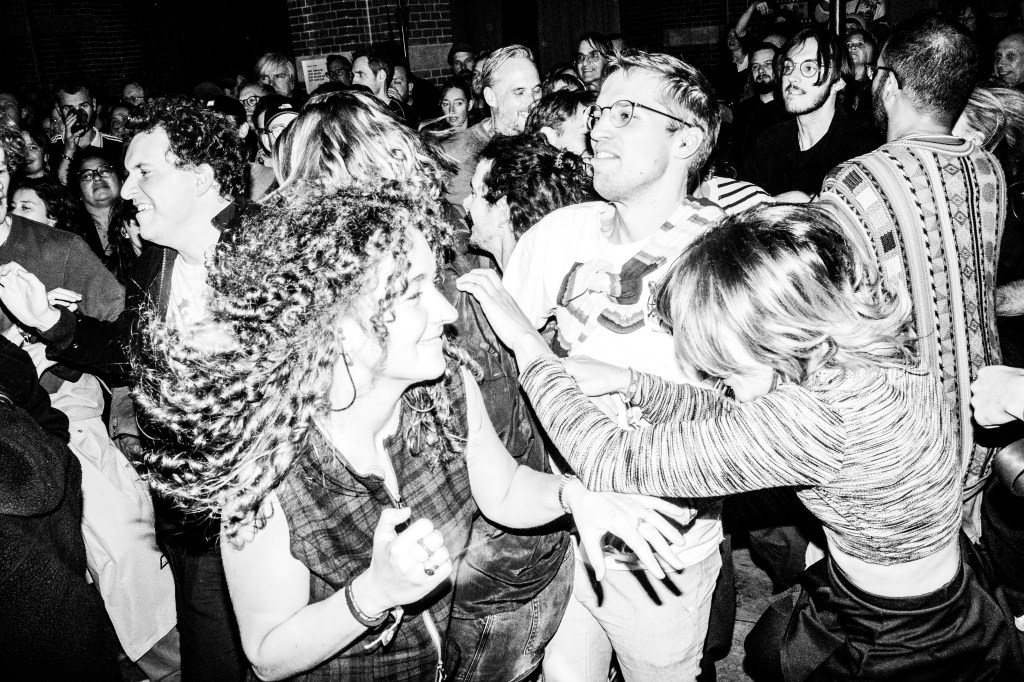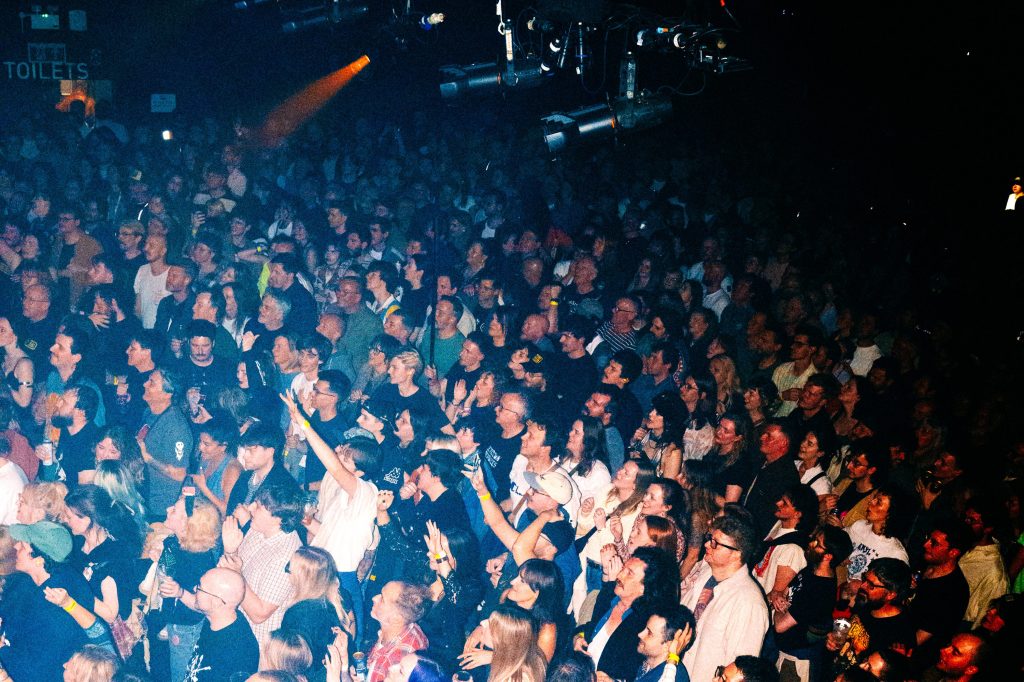
A profile of the word-of-mouth mystery that is Jim E. Brown, following his latest run of UK dates.
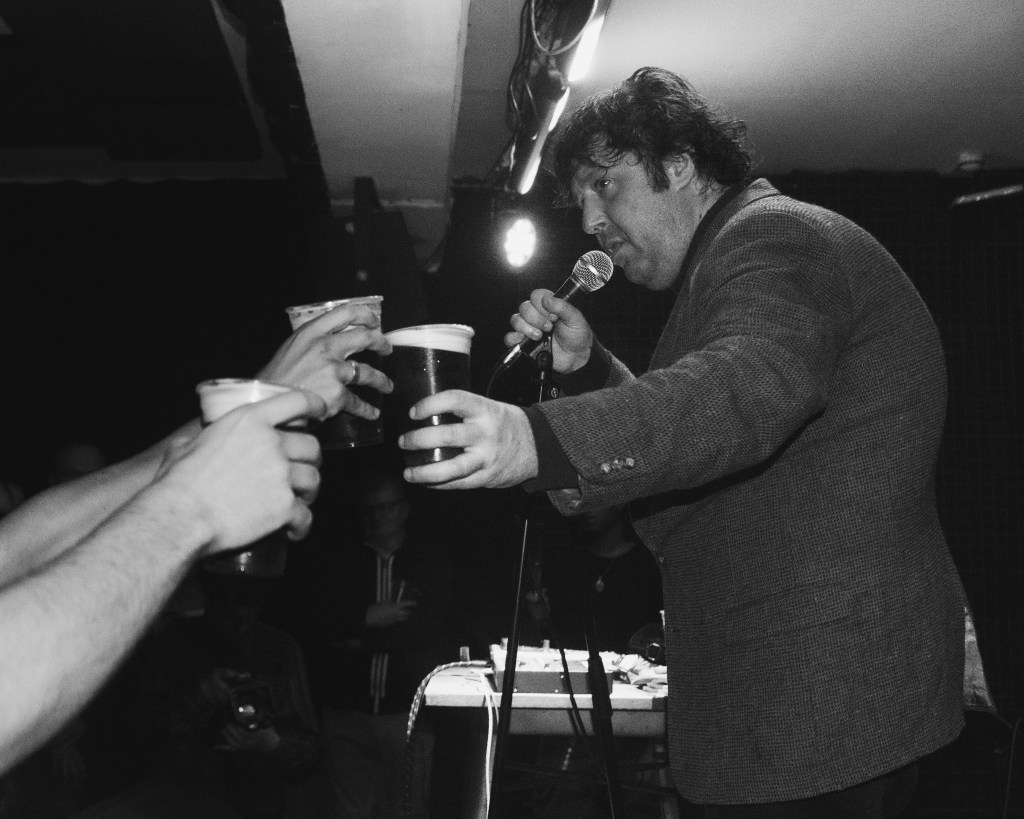
“Should I perform this song, or should I just drink more Guinness?”
This is a question that has long plagued the age-defying 19-year-old songwriter and performer Jim E. Brown, whose lifelong struggles with alcoholism are at the heart of his songwriting. Across two sold out shows at New River Studios last month, he once again wrestled with his demons. Though seeming to indicate a preference, on this occasion, for singing his songs, Brown nonetheless commanded audience members to bring him offerings from the bar in order to maintain “a constant stream of alcohol in my blood”. All this in spite of evidently having an ample supply of rider cans of Stella already with him on stage. Brown’s supports for these shows, Daffodils and House Arrest, both served as judicious openers, manifesting in the open the kind of chaos and hedonism that seems to constantly terrorise Brown internally.
But who is Jim E. Brown and why are his fans so devoted as to oblige in such ridiculous offers? In the past, audience members have willingly offered themselves up to have salad cream squeezed into their mouths by this shabby Didsbury demi-God. At New River, several people waited after the show to get fan art signed by the great figure. What is it about a man singing about being a rat trapped in a bin that so appeals to this strain of London gig-goers? Mass culture has long been obsessed with the troubled artist archetype, and as seen here the problematic indulgence and reinforcement of such behaviour is exhibited by Brown’s audience. But is there more to his mystique?
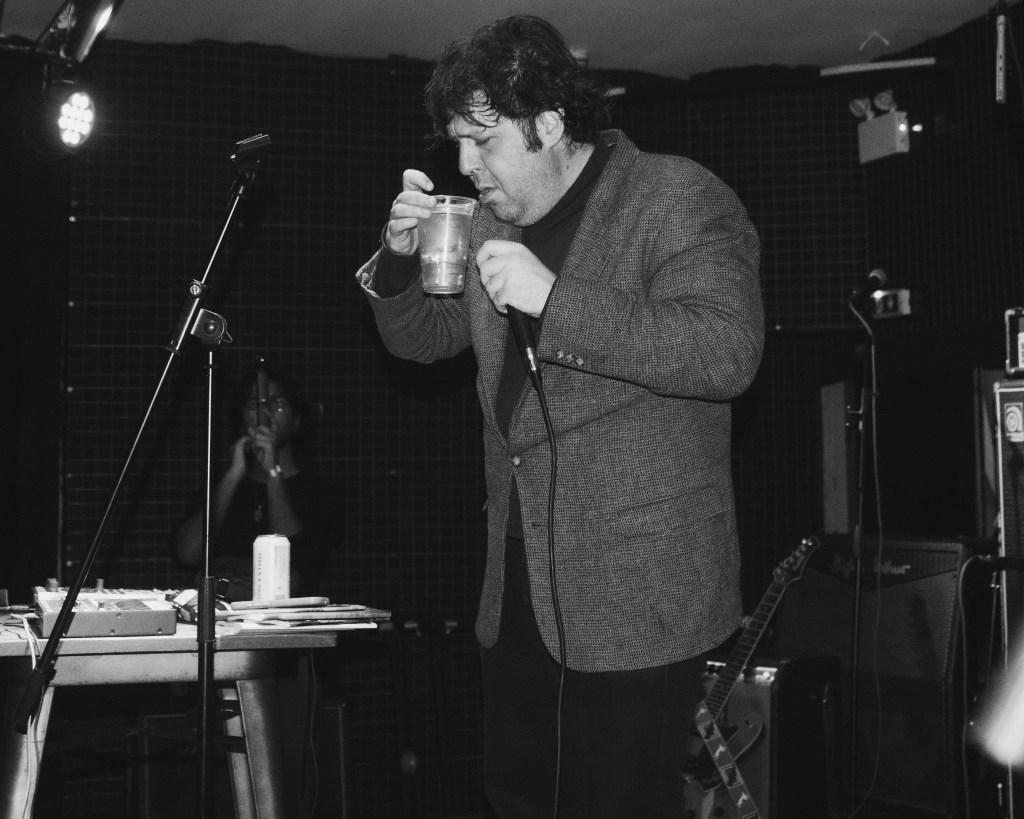
Brown’s appeal is almost unique among underground acts at this moment. He commands the kind of word-of-mouth buzz that is the mark of a great act. Flash Delirium, who organised the New River shows, have been instrumental in building his reputation in London and Paris, putting on his first shows in both cities and organising subsequent shows for bigger and bigger audiences. The pattern seems to repeat everywhere Brown goes as he amasses fans across Europe, Australia and the US, particularly in Philadelphia, where curiously he seems to go down as well as any native.
The cultish attraction is furthered by his prolific social media presence. This is a space which has catalogued his struggles with sobriety, the ups and downs of his relationship with former partner Brittany, and where at one point he was simply declared dead. Those interested in Brown’s precociously storied life can find out more about him in a number of autobiographical books, including Brown on Brown (Vols. 1-3), Shattered: Losing My Son Tanner, Learning to Love Again and A Holiday with Mrs. Higgins. Yet for a figure who has shared so much personal detail in the public sphere, Brown remains something of an enigma. Some, even in the face of his extremely local songwriting, suggest he isn’t even from Didsbury at all! It is this paradox of public disclosure and persistent uncertainty that seems to create a unique fascination with Jim E. Brown.
As a performer, Jim E. Brown feels something like a twenty-first-century descendant of John Shuttleworth, a younger, messier equivalent from the other side of the Yorkshire-Lancashire border. His songs immerse us in the outward details of his character as related to his locale, reflecting on British life particularly through products, in Brown’s case often fast-food and alcohol. Shuttleworth has his own explorations of Brown’s locale, his ‘You’re Like Manchester’ similarly rooted in the specific locations and neighbourhoods around the city. The two feel like similarly drawn caricatures of British life, and indeed perhaps it is simply something in Brown’s embodiment of something inside all of us here in Britain that makes him such a compelling voice in this country’s musical landscape.

Anyone familiar with Manchester can appreciate Brown’s use of local detail, while his detached style, as evocative of a scan of Google Maps as the lived experience of a resident, allows outsiders to understand his narratives too. The second verse of ‘I’m Writing Love Letters In McDonald’s’ is typical in this regard. Having established that he is writing from ‘the one on Princess Road’, Brown adds:
I’ll send my letter by Royal mail
And I hope it won’t fail
There’s a post office nearby
[and here’s the kicker]
On Stretford Road
Another key reference point for Brown’s music is Getdown Services, and in this regard we might consider the limits and the perversity of Brown’s own appeal. With work similarly immersed in a British mundane set against danceable tracks, Getdown Services produce something definingly uplifting and optimistic out of the dross of British society. At End of the Road this year, the mood at their set was euphoric, converting the doubters into a unanimous, strangely uplifting singalong, punctuated by the band pointing at each other and exclaiming “That’s my best friend!”. Brown, by contrast, deliberately negates the possibilities of any such euphoria, instead criticising his audience, vocalising his self-loathing, and ritually consuming alcohol. And his crowds absolutely love it. It is this profane disgustingness that seems to create in Brown’s fans their peculiarly cultish buzz. At the same time, we might wonder about its ceiling. It certainly seems far less likely to win over an unsuspecting crowd having fun at a festival.
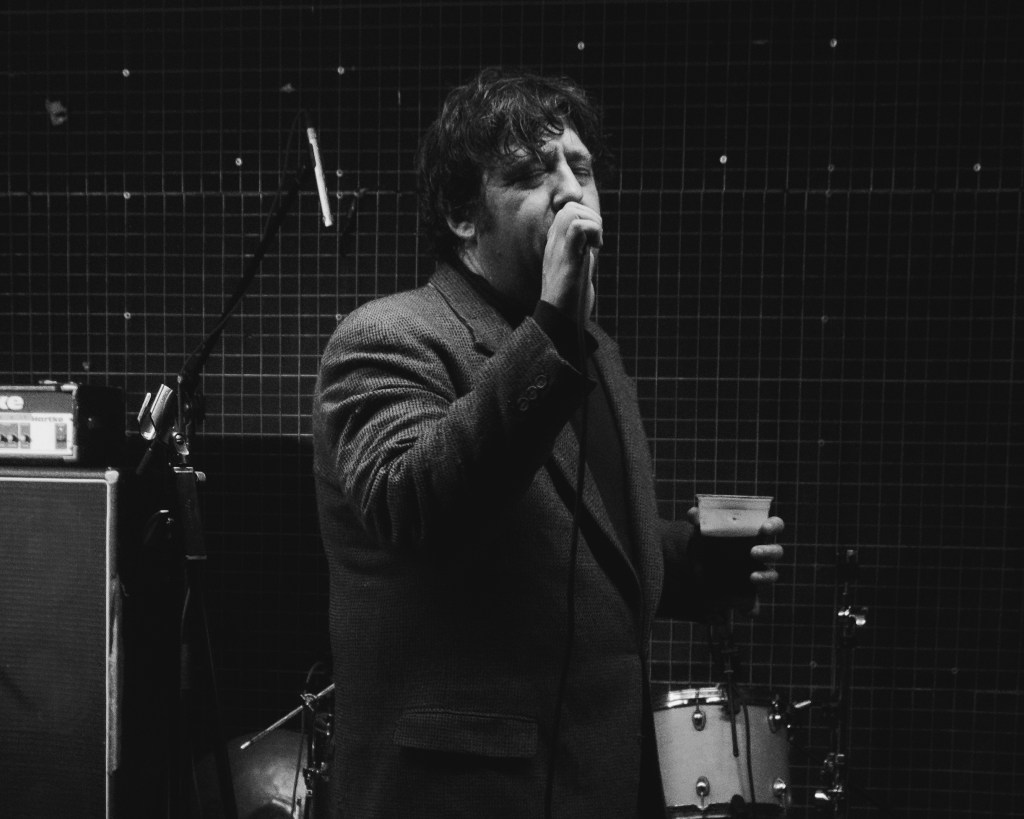
All the same, Brown’s own stage presence is perhaps enough for this to translate. Any lull in the show, indeed, almost any song intro, is punctuated by a yell of ‘MY NAME IS JIM E. BROWN’, a move that feels like it could have come out of the playbook of near namesake James Brown. And the songs are catchy. ‘I’m Quitting Prozac to Continue Drinking’ is set against an infectious Italo-disco-style backing. ‘I’m Writing Love Lettters In McDonald’s’ is a huge singalong moment. Even in the slower moments, our focus is unbroken by Brown’s commanding presence, as on the spoken piece, ‘I Can Smell The Mice Having Sex Behind The Walls’.
Jim E. Brown puts so much of himself into his lyrics, his stage show, his books and his Instagram page. Yet nobody seems quite sure of exactly where he came from. As far as anyone can tell, he burst into life, fully formed, as a nineteen-year-old obese alcoholic, whose only concrete biographic detail before that age is his birth on 10th September 2001. It is this paradox that really gets people talking, debating, and going back for more. There is certainly a problematic element to the audience’s encouragement of Brown’s worst habits, and at New River it seemed at times like he may have set aside his drink if the audience had let him. Accounting for this, one can only suggest that it is the unreality of Brown that inspires such a lack of compassion and indulgence in the mystery, reminiscent of the self-fulfilling mythologisation that fuelled Neal Cassady’s decline in his latter years. Brown, in his strangely vivid embodiment of British caricature, seems almost transcendent in his very realness. And so, to a growing number of fans, it is a peculiar form of blessing to be fed salad cream by Jim E. Brown, to buy him a beer, to watch him sing his songs, and equally to watch him drink a Guinness.