
The band discuss the maturation of their experimentalism and the Final Bosses defeated on their first full-length record.

Legss are one of the foremost London bands whose music truly channels their surroundings. Their songs are dense and churning, and even in moments of serenity there is a smoggy bite, a tugging at your trouser leg ready to drag you back in to the whirl. They burst onto the scene with the songs that became ‘Writhing Comedy’ (2019), an EP that contained some of the best material of that moment of post-punk revival, sprechgesang vocals and post-rock atmosphere. Since then, their sound has grown bolder, more intense, and more uniquely them, their latest EP ‘Fester’ (2023) expanding upon the band’s melodic potential and adding an emotive depth to their style. Legss also notably received an honourable mention in Simon Reynolds’ afterword to the 2022 of Mark Fisher’s ‘Ghosts of My Life’, adjudged to be worthy torchbearers of Fisher’s philosophy into the years after his death. That book collects writings of his which broadly explore modern British life in terms of the neoliberal political order and a declining sense of idealism, with large sections set against the backdrop of 21st Century London, the city which Loud and Quiet once described as Legss’ fifth member. It is further appropriate that the band met at Goldsmiths, where Fisher was a lecturer for a time.
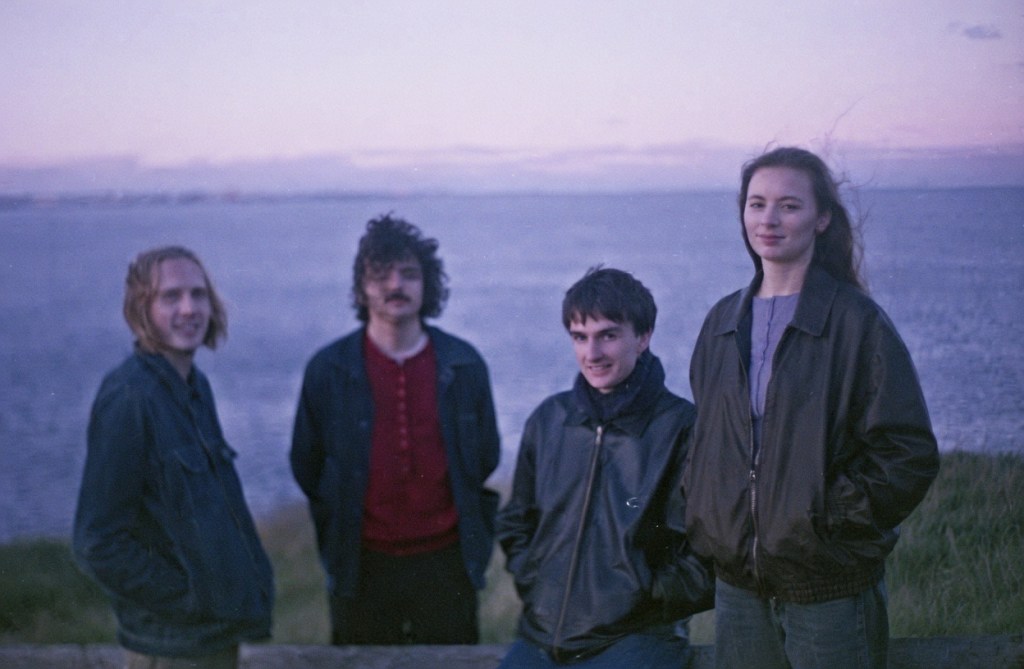
Actually, by their own estimation, Legss more likely met at go-to student haunt, the Marquis of Granby, just over the road from Goldsmiths. Appropriately, then, it was there I met up with singer/guitarist Ned Green, bassist Jake Martin and guitarist Max Oliver to talk about their debut album, ‘Unreal’, which releases this Friday (12th September). Enjoying being back in that familiar setting, the band reflected on their formative days.
“Legitimately we started in 2019”, Ned says, “when Jake joined and we worked towards releasing ‘Writhing Comedy’”.
Max recalls, “We might have done our first gig in 2018 but under a different band name…. we briefly called ourselves Self Help”.
“We were called Self Help before all the other bands were called Self Help!”, Ned adds.
“You know what?” he continues, more to the band than me, “I went in a pub the other day and someone’s like, ‘Oh you’re from Legss… 2019 royalty!’”.
“2019 royalty, oh my days,” says Max pensively. “I mean, we felt like small fry at the time”.
“It’s been a bit of a mythical beast”.
Seven years down the line, Legss have come a long way, even if, as Ned says, “we are still the same four lads who met at this pub”. Like many contemporary bands, financial constraints and the slowed evolutionary pace of a band also working full time jobs have limited them to experiments with the EP form, so it has been exciting to finally hear their ideas played out across the depth of a full album.
“It’s been a bit of a mythical beast”, says Max. The album has always been that far-off project for which their more grandiose ideas would be deferred. At the same time, the resultant product does not suffer from that ‘first novel’ weight of too many ideas being forced into practice for the sake of it. Instead, it demonstrates a discerning evolution of the band’s experimental flair. There is a kind of completeness to this record, underscored by its deliberately unusual elements but not dependent on them. Fans of the band’s earlier material may be struck by its wholeness, dispensing as it does with the rawer experiments of earlier tracks like ‘Letter to Huw’ and ‘Graduate Scheme’. Instead, it feels like the experimentation has been done in the rehearsal room before being brought to the studio for the creation of the finished work.
“We are still experimenting but in different ways”, Max explains. “Part of that is some level of maturing. I think while we’ve always wanted to experiment, a lot of our experimentation originally was by accident, or because we didn’t have the knowledge to write more cohesive music.”
Ned remembers back to a lost idea for a series of “skits” that would be interspersed across the record, forming “a fictionalised broadcast interview with, like, a high-profile Radio 4 broadcaster talking to us about splitting up”. That idea now behind them, he reflects, “We’ve always gone that high [raises hand above head] with ambitions, so that when it drops down to there [torso height], it’s still much more than what is traditionally accepted”.
In practice, the band decided to channel their ambitions for the record into the songs themselves, detailing them with the unpredictable musical elements that have long been their signature and newly augmenting them with additional layers of instrumentation and interludes. “The stakes got higher the more we started to write and record”, Ned says, the ultimate question becoming simply, ‘What is the best we have got?’
“That became the obsession, rather than trying to make it interesting for interesting’s sake.”
Appropriate to their more mature form of experimentation, ‘Unreal’ features Legss’ first incorporation of brass and live strings into their music. The effect does indeed establish something of a coming-of-age for the band, anchoring the operatic grandeur toward which they have previously gestured more through aesthetics and musical fragments than with their sound as a whole. “Our songwriting has become a bit more refined sonically and even emotionally”, Max comments, suggesting “it lends itself to this extra instrumentation”.
All the same, as Ned points out, these elements do not simplistically round off the sound of the record. “It fits with the album’s theme of unreality, wanting to push those dynamics in a way that feels uncomfortable. We’ve always been a band that pushes those dynamics to an almost excruciating degree”, he goes on, citing earlier single ‘Landlord’ as a prime example. In this sense, ‘Unreal’ shows what the band can do let loose with more than just two clean guitars, drums and bass. ‘Eversince’ feels like a particularly telling example, the final version circling around a yearning cello melody that teeters on the edge of turning into a caroline song but refuses to give the listener that kind of release.
“There’s a few Final Bosses”.
With its tidier relationship to the band’s experimental side, ‘Unreal’ feels like the culmination of what the project has built towards so far. “I’d definitely say there’s a few Final Bosses, like final versions of tunes”, Ned begins.
“The three singles are all the best version of similar sorts of songs we’ve done previously. ‘See No Evil’ feels like the Final Boss of the sort of sunny sad boy side that we’ve always had. ‘909’ is really stripped back to one note. We might have wanted to change that at an earlier point, felt like we need to have a few more different parts. [In that sense], it feels like a regression, but in a lot of ways it’s the final form of that type of song that we write.”
‘909’ is a particularly interesting song within Legss’ story and an idea that longstanding fans might be aware of from a long time back. “It’s followed us from basically the beginning”, Max says.
I remind Ned of a version that appeared on the lockdown compilation ‘Group Therapy’’, listed as ‘5 Live’. “Wow yeah… thank God that’s not on Spotify!”
The song is now formed of “the last part we ever added to it”, the other elements carved away like clay from the sculptor’s block. Max details its history. “It was this ridiculous, three-part, Pavement-esque operatic epic… none of those parts exist any longer. In the beginning we were obsessed with, ‘You can’t repeat things, you can’t do a section again, you have to find something weird’. And slowly we’ve kind of trimmed all that away when it feels unnecessary, and now we’re comfortable enough to hammer home something we think will stand up. In a lot of ways it is the most emblematic of our development”.
“What I would like is for everyone to be slightly hungover all the time”.
In its final form, ‘909’ takes us inside the head of a character whose “only form of comfort” is listening to familiar radio shows. This kind of perspective shows up over and over throughout the record, lyrical monologues creating characters whose relationship with the world feels only a small exaggeration of how many of us live our lives today. Perhaps the defining example is the burnout fantasy presented at one moment in ‘909’: “What I would like is for everyone to be slightly hungover all the time, and for me to be tipsy – one or two swifties in but nothing unbecoming.” It captures a peculiarly modern form of overwhelm at the pace of life and information today, a feeling that is screamed back at us in countless ads up and down tube escalators advertising products to make us healthier, more efficient and more productive, or at least more awake.
This is one sense in which Simon Reynolds’ relation of the band’s music to the work of Mark Fisher feels particularly fitting. In ‘Capitalist Realism’, he explores the psychological toll of late capitalist life, relating the current mental health crisis to the demands of the internet age and a new model of professional life built on instability, excessive self-determination and meaningless bureaucracy. It is this malaise that creates the characters of the somewhat aptly named ‘Unreal’, performative readers without time to actually read, commuters whose radio listening is all that keeps them sane. ‘Unreal’ is an appropriate title, not so much for the wealth of fictional characters as for their inner worlds’ fictionalised simplifications and exaggerations, created in the heat of 21st Century life’s incomprehensible information overload and work-life imbalance. The affirmations of the protagonist of ‘Nothing Would Make Me Happier’ frame it in perfectly city bro terms: “I see connections and potential in everything in the least spiritual way”.
A few years on, the band have been reflecting on their mention in Reynolds’ ‘Ghosts of My Life’ afterword. As Max points out, they were in some ways quite a different prospect at that moment in 2022, “more overtly, aggressively experimental”. On the other hand, however, the ideas Fisher expresses speak to things the band have collectively apprehended and continue to explore artistically, if only as “semi-formed feelings about the world we live in”.
Ned agrees that on a “base level”, Fisher’s distillation of the contemporary Marxist ideas of “dissatisfaction with contemporary society… is something we’ve always channelled and tried to articulate to varying degrees.” He argues they are not “the archetypal Fisher project… not far enough into the industry to dismantle from within [or] far enough into the DIY to be creating new subcultures that exist outside of traditional forms… we’re never gonna be Burial!” Ultimately, however, he feels that “for our resources and politics and ethics, we’re about as worthy of the mention as anyone else”.

“We put ourselves in a room together and out of sheer will create what we’ve been aiming to do the whole time”.
The band all work full-time and what they put into the project in terms of time and money is checked by the realities of their daily lives. In this sense particularly, they respond to the same realities that colour the subjects of Fisher and his contemporaries. Ned details the band’s evolution. “It’s not unique, but I think starting when we were coming to the end of our uni period, and then traversing that middle period of trying to keep uni life alive, and then moving into full time work… it’s an interesting period to document artistically. To navigate all the things that come with full-time, part-time work are rich creative things to pull from”.
When it comes to setting down those experiences, it has become a case of juggling four conflicting and limited sets of availabilities. Though they don’t consider themselves an “on-off” band, given they are constantly developing ideas remotely or independently, their work in the room together often takes place over very limited time periods. “We’ve had to work around life”, Jake says, “but it has granted the longevity of the band”.
Max continues, “What we’ll do is carve out a period of time, this happens maybe three or four times a year, we’ll sit down and go through all of our calendars, book off a chunk of time. Then we put ourselves in a room together for a few days and out of sheer will create what we’ve been aiming to do the whole time”.
“And it is fiercely productive”, Jake adds.
“I think”, Ned considers, “bar going delirious in the van, the best possible thing about being in a band is the first time you all play a new song from start to finish… that first time you go, ok let’s do it one more time, and you all put your phones in the middle to record, and you know you’ve nailed it and you know you’ve got a finished song… but being mad in the van definitely still tops it!”
The band feel the workability of this intense approach is entirely down to their cohesion as a unit, a product of years playing together and understanding what each brings to the project. In a sense, it is almost as if this urgency defines the music they make. As Ned sees it, “I honestly can’t imagine what we’d be like if we were rich enough to not work and could write and record all week. We’ve just learned over six, seven years of being together that when we are together we can get it done. We know each other’s characters and personalities so well that it always just happens.”
Jake suggests, “I think as well that’s why recording the album went so well, because we’d had so much practice learning how to work in a short period of time, in a confined space.”
“We could do it all again”, Ned laughs, “it’s just that we don’t have a four-day gap until 2027!”

 Hard Of Hearing Magazine