
With their debut album out this Friday, the band discuss the intersection of folk and punk, the importance of the volcano, and why they all secretly want to be Jedis.

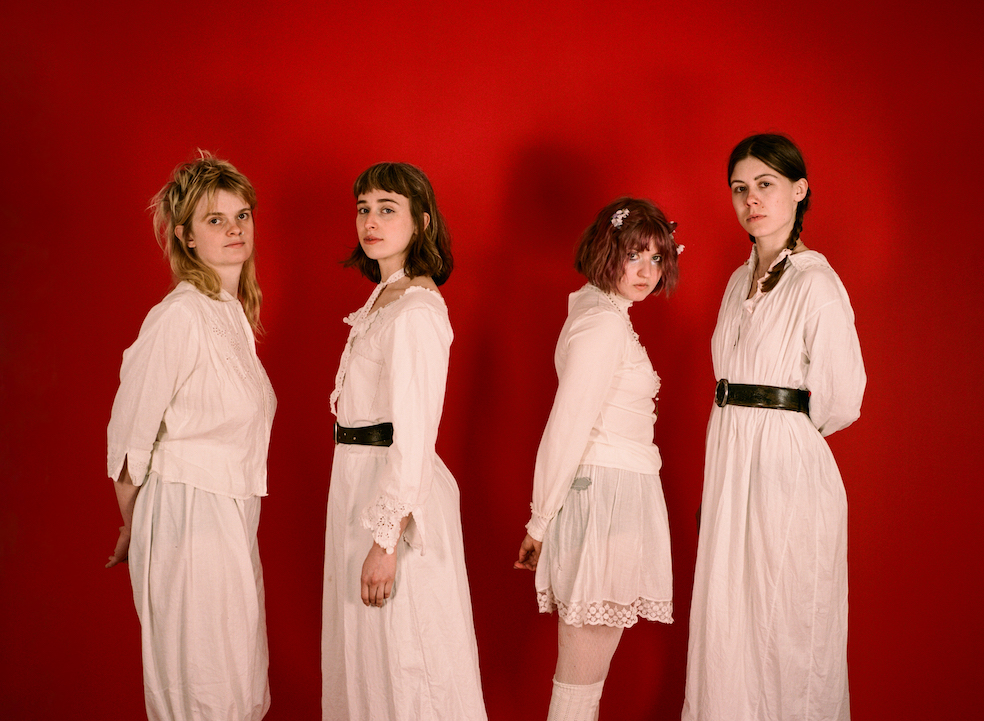
The New Eves arrived explosively. A few months and a few gigs into their existence, they played one of the Windmill’s Cello Sunday nights and immediately became a must-see band on the scene. Since then, the Brighton quartet have put out a string of singles – debuting with ‘Mother’ on ‘Slow Dance ’22’ – and won over countless fans with their electrifying live set. Formed in Brighton, the band consists of four songwriters, Nina Winder-Lind (cello, guitar, vocals), Violet Farrer (guitar, violin, vocals), Kate Mager (bass, vocals) and Ella Oona Russell (drums, flute, vocals). They work at the intersection between punk and folk as if it is the most natural combination in the world, reigniting those traditions for the 21st Century. With debut album ‘The New Eve Is Rising’ releasing this Friday, we spoke to the group about the relevance of this musical fusion and the sprawling collective philosophy that has shaped The New Eves’ music so far.
“It’s about what it’s like to be a person, in a place full of other people and animals and elements”.
It feels as though there is a clearly defined world of ideas built into The New Eves, the name perfectly appropriate to a band whose music seeks to reinterpret myths and the history of human experience through their own subjective punk radicalism. The track, ‘The New Eve’, lays out a kind of manifesto, oscillating between the idiosyncratic and the universal. Band names can often be incidental, relatively arbitrary, but in this case, as Ella reveals, it was central to the solidification of the project.
“We were sitting around looking in books of plants, geographical books, and looking at different rock names… then it suddenly kind of hit us. I think it really opened up this new idea of the direction we could take the band in”.
With the name decided, the group’s loose jam sessions suddenly coalesced in an explosion of creativity. Ella elaborates, “It was like finding the name really made us form as a group, we connected with each other a lot more and we started having these electric sessions writing crazy songs… I think it somehow eliminated shame between us”.
Kate adds that with the name came a degree of organisation of ideas. “Giving a name to something makes it more real, it makes it something to interact with, a place to put those ideas.”
Although the immediate associations of the Eve archetype suggest a particular interest in femininity and its contested histories, the band see their remit as more open than that. As Ella puts it, they want to “reexamine” that myth, but further to explore human experience more generally. Discussion of the female experience is, “An obvious part of what we’re saying because we’re four people identifying as women. I wouldn’t say it’s not important, but I think we all agree that it’s much bigger than that. It’s much more about what it’s like to be a person, in a place full of other people and animals and elements.” The result is the band interpreting this whole in relation to the singular – “We do still relate all of that stuff to our bodies and how we feel in our bodies.”
“I think we’re all quite big fans of volcanos”.
Given the rich, wide-ranging extended universe upon which The New Eves’ music holistically draws, it makes sense that the band have a strong visual identity, rooted in natural imagery and appeals to punk lineage as well as the constellation sometimes broadly designated as ‘weird folk’. “It’s just as big as the music”, Ella asserts. The brilliant video for ‘Original Sin’ sets the band up in a Top of the Pops-style mime performance (hosted by friend Edward Deeney, fka Woody Green) before cutting to footage of the band out in a field eating apples. Meanwhile, in the video for ‘Cow Song’, the quartet dash and dance around a forest in Sweden dressed all in white, at points pausing in some kind of improvised ritual.
Considering the powerfully visual language of The New Eves’ work, I ask if there is one core image that defines the band. “Are we all going to say the same thing? I know what I’m thinking!”, says Violet, drawing a knowing laugh from the rest of the band. “If we had to have one image, I would say a volcano. It’s like the power of land – the lava comes from deep inside the earth and transcends things, washes things away… creation and destruction.”
“I think we’re all quite big fans of volcanos”, Ella affirms. “That’s the beginning of the world, rocks being made.”
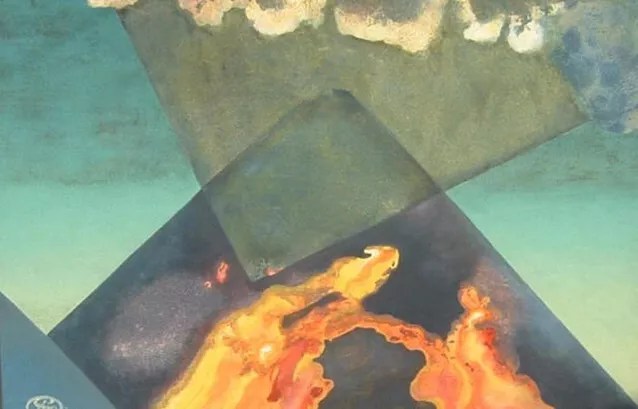
Drawing on a similar world of references, 20th Century artist Ithell Colquhoun drew also on the idea of the volcano as the ultimate image of creation. Her short essay, ‘Fire and the Pyramid of Flame’, traces the symbolism of fire and the volcano, beginning with the widely accepted idea among ancient Greek philosophers that the universe evolved from fire. She also cites ‘The Chaldean Oracles’, which describe fire as “‘the fountain of ideas’, which fly like sparks issuing from a firey whirlwind”. In these philosophies, she explains, The Pyramid of Flame is the visual symbol of the fire element, anchoring in theory the natural fascination with the image of the volcano.
Ella acknowledges that Colquhoun “definitely falls within the sphere of the New Eves”, although their own song, the epic 8-minute album closer ‘Volcano’, draws as much from direct impressions. The song, she explains, came out of her and Nina jamming after watching videos of the volcanic eruption in Iceland in 2021. “They were showing all these incredible pictures of the lava flows and we got really excited… it’s a big deal that song.
“And I think that’s where I really felt confident with drumming. I hadn’t drummed much before but then I was like, ‘I’m gonna try and drum like a volcano’”.
“The way we play has a very punk energy… I do a lot of hitting”.
Along with the music’s folk associations and the strong lyrical grounding in occult and natural imagery, The New Eves function equally in the terms of a punk band. Their music draws on a lineage that reaches through The Raincoats to Patti Smith and Television and Nuggets-era psychedelia, but equally importantly, their approach and methodology anchors this style with a truly DIY philosophy. The band themselves do not tend to think of genre labels in regard to their compositions, but as Violet sees it, “The way we play has a very punk energy… I do a lot of hitting, rather than playing chords.”
Nina suggests, “I think the most punk thing you do is play the violin.” She sees the band as built on the primacy of expression over technical ability. “Violet started playing the violin when we started the band and Ella started playing the drums. So that feels punk.
“I think there’s a key here. We never say, ‘We’re going to do a song like this,’ or ‘We’re gonna be a punk band’, everything just happens, without us deciding anything.”
“We just play and other peopletell us what we’re doing”, Ella adds. “We don’t have any references going in, which is really exciting because the sounds we make are purely what comes out when you mix the four of us together.”
Most of the band’s output to date is derived from collective jams in the studio, the product of their creative relationship in a particular moment. Ella hones in on what such moments could be. “Half the time, that’s someone walking into the studio in tears, or flapping in half an hour late covered in sweat. It’s all very real. Someone comes in and they’re like, ‘I just read the craziest article about beetles!’ And we’re all like, ‘Woah!’, and then we start playing music together, and all of this stuff comes out.”
“The aim was to capture the live experience.”
When it came to recording this first collection of songs, the band knew they wanted to hold onto that sense of immediacy and truth. “The aim was to capture the live experience and we wanted to record as much of it live as possible”, says Ella. She credits producers Jack Ogborne and Joe Jones as, “The exact right people to capture the essence of what we were doing… They were in the same headspace as us, really interested and wanting to explore”.
‘The New Eve Is Rising’ was recorded at Rockfield Studios in rural Wales, keeping the crew intimately together on site, something the band see as a benefit. As Kate puts it, “Being away from the outside world [meant] none of us were going home at the end of the day and having to worry about needing to do a food shop, or the laundry, or whatever. We were all in that headspace the whole time”.
The band knew Ogborne well going into recording; he had in fact recommended them for a very early gig in Bristol. They were initially less close with Jones but say “it was amazing to discover that he was just like one of us”.
“Every day he brought out this new thing”, Ella continues, explaining the variety of pieces of sound equipment he had on hand. “He had these bat detectors we were recording with”, a process she explains involved singing into the monitor to capture only the highest vocal frequencies (try and figure out which track that features on!).
“He also had this amazing thing, we didn’t get to try it, but I think it was like a coil of metal that you can plug in, it’s got an XLR, and you can hear every time lightning strikes the surface of the planet… like anywhere.”
This device sounds very much like a mechanical equivalent to The New Eves. “Yeah that’s the next album”, agrees Kate, “just lightning strikes through a bat detector!”
“People are like, ‘oh they’re freak folk’, but actually we’re very sci-fi in our hearts.“
In a way, the punk epithet feels easier to earn than folk, its conceptual emphasis being on DIY approach, pure expression and disregard for technical virtuosity. Folk can feel in some ways more exclusive, revolving around pre-existing material and particular playing styles. What The New Eves draw on from folk, however, is very similar to what they take from punk. “It’s definitely folk”, Violet asserts, invoking its broadest interpretation. “Folk music is just the music of the people, so in that way, we’re singing for everyone. And there’s a lot of pastoral imagery.”
Nina echoes this. “Sometimes I get annoyed when people say we’re a folk band, but then if you look at it, folk music is very much about, ‘Hey everyone can play, I can teach you how to play the fiddle, you can do this and you can do this and we can all sing’. In that sense, it’s very close to punk music and it’s very close to what we’re doing.”
Nina frames it as something of a punk gesture to apply punk philosophy to a subject traditionally far away from the genre. “Punk music has always been tied to the city, and it’s cool that a city can have a voice like that. But it’s also cool if a field can have a voice like that.”
“That was the punk of the last century,” Ella agrees. “Everything’s evolving all the time, and it’s nice to be channelling the new energies and picking up on what society is now and what it needs… I think it’s punk to love the Earth.”
Reflecting on the current appropriacy of folk aesthetics to punk ideals, we discuss intimations of the future, and how this should be reflected in music. Where the synthesiser was once the obvious herald of the coming age and a symbol of posthuman evolution, in our age of climate crisis the conservationist ideals of folk and the earthy tones of a fiddle can feel arguably more important to the collective cause of humanity.
“For us”, Ella says, “The future is a marriage between those things. We do love a synthesiser as well as a fiddle. I think they are, in some ways, the perfect duo”.
“Sci-fi animism, that’s our future”, Kate adds.
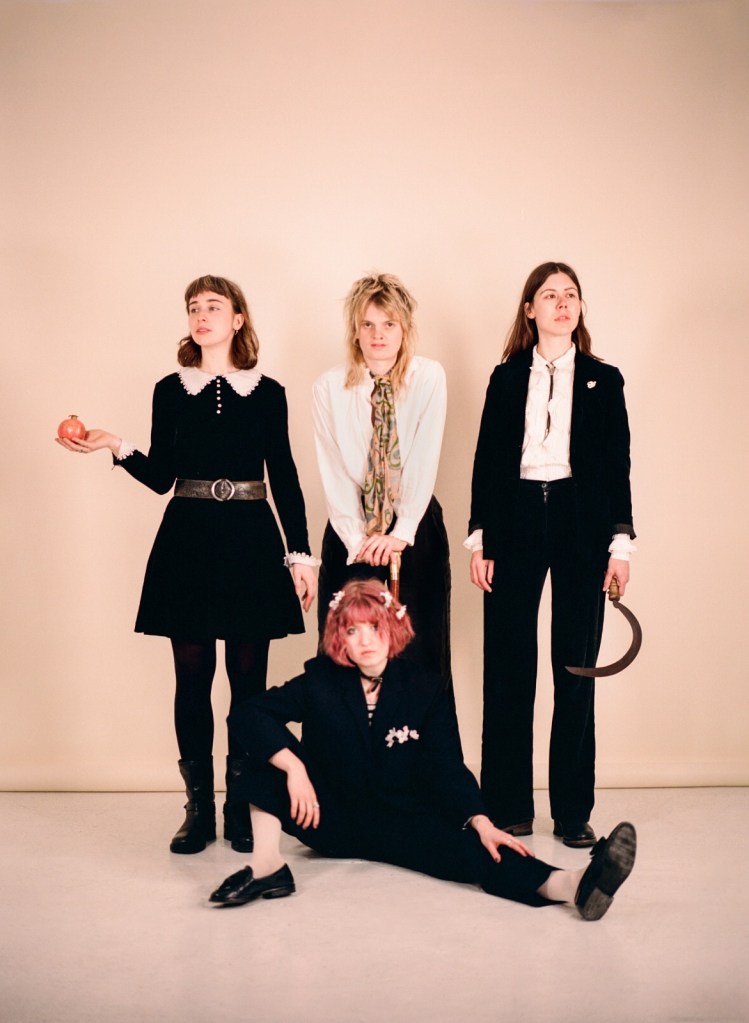
“We always say we’re a Star Wars band”, Ella continues. “We say this to everybody and everyone leaves it out of print! But it’s true, we’re quite sci-fi. People are like, ‘oh they’re freak folk’, but actually we’re very sci-fi in our hearts. We feel like we’re Jedis. I don’t know if it looks like it from the outside, maybe we’re very deluded. But everyone thinks they’re Luke Skywalker.”
Improbable as that may initially sound to anyone familiar with the band, there is something in this. The Jedi combine occult wisdom with the futuristic technology in the service of a cause intended to save the universe from the forces of evil. Returning to the historic significance of the volcano and the flame, Ithell Colquhoun also notes that 20th Century mystic Madame Blavatsky reinterpreted fire in positive terms as “the prophecy of electricity”. So perhaps the lightning-strike bat detector album really is the natural next step for this band, at least if they want to be taken seriously as Jedis.
It is a rare and enchanting thing for a band to have such a deep, developed world as exists around The New Eves, drawn in their case from personal instincts combined with a sensitivity for the artistic traditions that inspire them. The New Eves’ output is the product of a fertile hive mind, on the same page about the essentials but also “all nerding into” different things, as Nina puts it.
Kate captures the appeal of this approach of channelling interesting concepts into popular music formats. “Sometimes it’s easier to say something with music than words. You can have quite a complicated idea to explain, but you can get the feeling across in a song.
“When I wrote my dissertation, I was trying to get people to read it. I was like, ‘I’ve said this thing that I’m really excited about!’ But nobody’s gonna read my dissertation.”
“I read it!”, Violet interjects.
“Well one person read it… In songs, I get to channel those things but put it in a form that’s more accessible to share with other people.”
The resultant record from all of these studies is no dry conference of weird folk and punk culture, rather a joyous channelling of these influences through the lived experience of its four performers. “I feel like The New Eves is a culmination of everything I’ve been through”, Violet concludes. “Everything I’ve done makes sense because of The New Eves. I feel like it was my destiny to be in this band – it’s very fucking important and beautiful.” ‘The New Eve Is Rising’ bottles a manifesto that goes beyond ‘The New Eve’ song itself. The New Eve is not programmatic; this is the sort of manifesto that allows for play, for reinterpretation, for imperfections and the indeterminate. It is an eruption: ancient and newborn, violent and true, capturing on the human scale something that reaches far beyond us. Very fucking important and beautiful.

 Hard Of Hearing Magazine