
In the wake of the release of their debut album, we discuss Britain, Brat and what it means to be Famous.
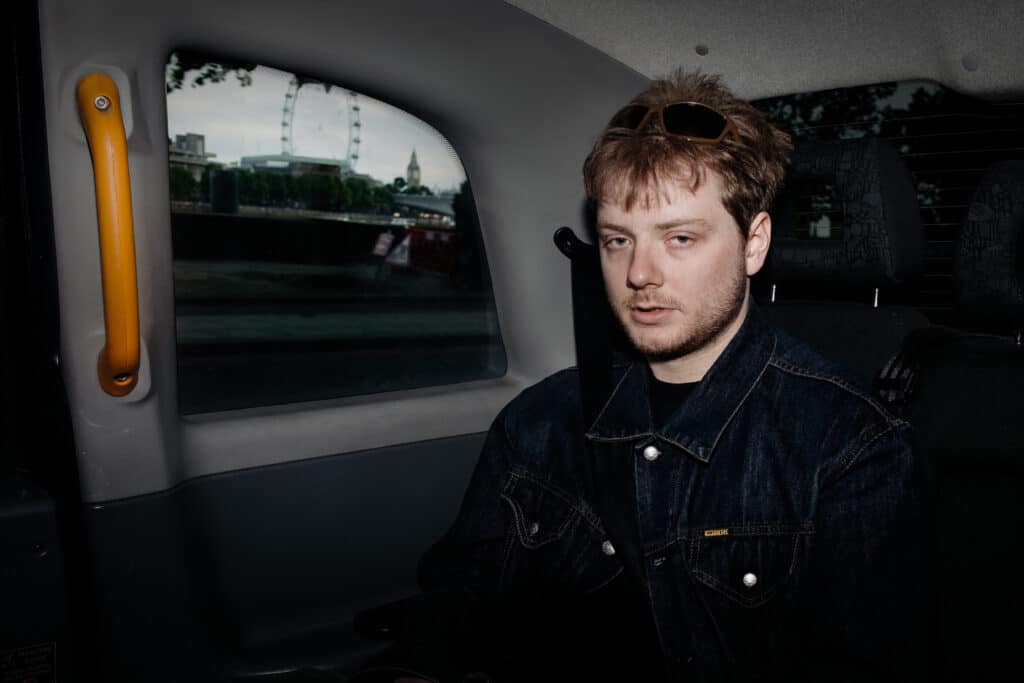
Famous are back at long last with their debut full-length, ‘Party Album’. The band’s enigma has developed over the past few years, and not only as a result of their Google-resistant name. Having burst onto the scene as a six piece, with members including Jerskin Fendrix and deathcrash’s Tiernan Banks, Famous are contemporaries of the likes of black midi and Black Country, New Road. By the time they released their debut EP ‘England 2’, they had built a similarly feverish audience who would devoutly pack out live shows, in spite of a minimal social media presence. The band then reemerged as a three-piece, releasing followup EP, ‘The Valley’ in 2021. This took the sound to an even more intense place, the lyrics darker and the music itself even stranger, mutilating rock, country and punk through hands-on post-production. Now, after a relatively quiet few years following dates touring ‘The Valley’, the band have re-emerged in earnest, with a new four-piece lineup and a record that seems to fulfil everything the band has aspired towards throughout its formative years.
Lead songwriter Jack Merrett is the band’s only consistent member, and we caught up with him to discuss the new album and what it means to be Famous. On his role, he elaborates, with a knowing self-deprecation, “I’m kind of the annoying arbiter of when [a song] has got to a place where it’s done”. It is an instinct he stands by, and he suggests he does not pick holes in something for the sake of it, but does admit that he can only explain it as “an unhelpfully vague” sense of completion. He has never made himself the face of the project as such, and appropriately the ideas and influences can come from anyone, and indeed hints that the current incarnation of the band is more collaborative than ever. It is this attitude that perhaps permits the heavily produced songs that the band end up with, and which informed the album’s unusually long recording period, as well as its first dabbles in co-writes. “Generally speaking, it’s trying to get to this place and whether it’s my idea or someone else’s that gets it there I couldn’t care at all.”
The idea of a kind of spiritual guide for this band makes a lot of sense, especially when the lyrics double down in self-reference, not simply autobiographical but also band historical. Fans first heard the title of this album on ‘The Valley’, where during ‘Modern Times’ Merrett sings, “The party album’s here, and it’s so much better than we thought it could be!”. In hindsight this sounds like part one of a masterplan building up to this release, though as Merrett laughs, “there are many different masterplans… [not all] the light of day”. The lyric, he says, was written with ‘Party Album’ in mind as the title of ‘The Valley’, but this was vetoed by others involved in the release.
That the impulse lingered up to this record suggests the validity of this purported band identity, though it is also attached closely to Merrett’s personal experiences, which strongly inform the lyrics. Struggle with addiction is a recurring theme across the album, musically juxtaposed by pumping music that often spills towards the obnoxiously fun and immediate. ‘Party Album’ felt like a natural title to address and revel in that juxtaposition, and as Merrett puts it, “I’m probably not going to be writing about my heroic struggles with addiction forever… [so] it felt like now or never” to parenthesise that period with this title.
Returning again to the idea of this band having its own meaning beyond any of its members, Merrett explains the appeal of this juxtaposition as being “quite Famous, at least as I understand it”. For him, it captures a defining quality that runs across their discography, “The through line of tension between being upfront about some fairly sad and serious things but also… that it’s almost a joke”. Merrett qualifies the idea of a band ‘meaning’, pointing out, “It’s as conscious as anything you’ve been doing for the better part of a decade can be… which is probably not very”. All the same, there is a hope that this self-contradicting band identity ultimately communicates a sense of what it is to be human. They see their work grasping at the question, “What if all of this unremarkable froth around us had some greater significance?”… or at least “wouldn’t it be fun to believe” that this were the case. Merrrett says, “I feel that human beings are remarkable in their way, regardless of who they are or where they come from”, and with Famous, the aim is “to see wonder and beauty in places where that beauty might easily be missed”.
In the wake of Brat Summer, it is impossible not to look to ‘Party Album’ as some kind of inverted twin to ‘brat’. Indeed, its title ironically draws attention to its discussion of the problems associated with 365 hedonistic partying. Yet this discussion would not be so essential were the cover of this album comparably, indelibly, unignorably bright green. Though brighter and more luminous than ‘brat’, in the current climate this comparison is still entirely inescapable.The original idea, Merrett explains, was to simplify the social media and visual campaigning by creating an easily replicable design, which would also establish a single colour with which the band would be associated. “And then obviously that went incredibly badly”, he laughs. It was a good strategy, unfortunately it was simultaneously conceived by one of the biggest publicity teams of the year. As such, however, it does set up the unlikely but entirely appropriate pendant pairing of the two records.
The other detail of the cover is its title in a font that incorporates the Union Jack, which offers more to unpick. The band have frequently explored British identity with ambivalence, the Shard haunting several artworks and videos and Merrett’s lyrics focussing consistently on British experiences, even when mediated by images and settings from overseas. This album continues that motif, as with ‘Love Will Find A Way’, which has throwaway lines about e-liquid and rewilding London. On the use of the flag, Merrett is quick to assert that this is not an attempt to make some expressly political or ironic reclamation of the flag from its problematic imperial history, though he does acknowledge that it is instinctively “tongue-in-cheek and a tiny bit provocative”. The band’s predominant imperative, he explains carefully, is an effort to communicate, “A childlike conviction that this is a magical island where, from time to time, it is still possible to catch sight of the Lamb of God.” Appealing to the fact that, parallel to its chequered history, this is the country of “The Beatles, J. M. W. Turner, George Eliot and William Blake.” Ultimately, he reflects, “I’m unfashionably romantic about this country,” suggesting a drive to challenge the too-easy rejection of any pride in our home country. “Perhaps it’s just a temperamental thing… I guess I’m kind of a sunny person”.
‘Party Album’, then, is an album made in Britain that attempts to encapsulate universal human experiences without disavowing its national peculiarity. The lyrics clash sober realism with flights of romanticism and flashes of rage, and these moments of joy and sadness are symbiotic, both feeding into the establishment of this sentiment. The incompatibility of these overarching concepts with our brittle human frames is bottled in the processed and abstracted music over which the lyrics are delivered. The party might be over, but there is more to life than that. “It’s just beginning, and it goes on forever”.



 Hard Of Hearing Magazine