
Ahead of the release of his debut album, ‘Bats Feet for a Widow,’ we delve into the process and self-teaching that shaped it.

Bingo Fury brings with him an way of perceiving life, moods and smoky scenes, evoked by atonal pianos, screeches of cornet and overlapping memories of basement venues and lonely walks home. ‘Bats Feet for a Widow,’the debut album from the Bristol-based artist known to civilians as Jack Ogborne, releases on Friday, an impressive, whole work that captures the best of the 24-year-old’s imagination for experimentation and modernist expression. At his most expansive, on tracks like ‘Unlistening’ and ‘Centrefold,’ he approaches the space and longing of Scott Walker, while more jerky tracks like ‘Mr. Stark’ and ‘Power Drill’ bring jazzy overlays to post-punk inspirations, This Heat being a name he highlights specifically.
The project’s roots are to be found in Jack Ogborne’s piano-playing lifetime. A multi-instrumentalist, his first musical venture was playing drums in a local church band around age 7, “a kind of Christian soft rock” situation. He picked up the guitar around age 13 and slowly began writing songs of his own, some of which found light in his previous project, the relatively straightforwardly post-punk band Norman, which disbanded in 2020. Parallel to his work with Norman, which took place while Ogborne was at university in Brighton, he began teaching himself piano. He invested in a piano, bought on a payment plan and worked to teach himself, deliberately forcing himself into a situation of, “Oh I’ve committed to this now so I’ve got to.”
Consistently rejecting formal training, Ogborne explains that “I wouldn’t want to learn an instrument with a teacher because teaching yourself is such a mindful and meditative process.” Listening to the album, which contains some very competent playing but also doesn’t shy away from creating awkward shades with atonal moments, one can begin to trace it back to this insistence on this consciously naïve approach. Ogborne likes the idiosyncrasy that such practice encourages, though he does admit that it lowers the ceiling for how far he finds he can push himself. With piano, he has “got to the point where I wasn’t surprising myself that often” and is currently moving on to the clarinet. “I have quite a short shelf life with instruments,” he laughs.
The room for embracing that “meditative” feeling is to be found all over the Bingo Fury catalogue, but it is always undercut by a tension that shows up across Ogborne’s work, also at the forefront of Norman’s music. Remembering that band’s last show, a support for Lice at The Cluny in Newcastle, he fondly recalls how it was the only time he’s ever been in the mosh pit of his own gig. Taking place on the eve of the first lockdown, the room was rather sparsely populated. “It was that violent thing that happens when there aren’t enough people to fill up the mosh pit so there’s a lot of space between all the people involved, which means you get a lot of momentum…” He tails off, noting that it was one of his favourite gigs that band had ever played, yet had this “slight subliminal feeling of ‘this is going to be the last gig you ever play.’” The first lockdown was announced the following day, and the band announced their break-up that July.
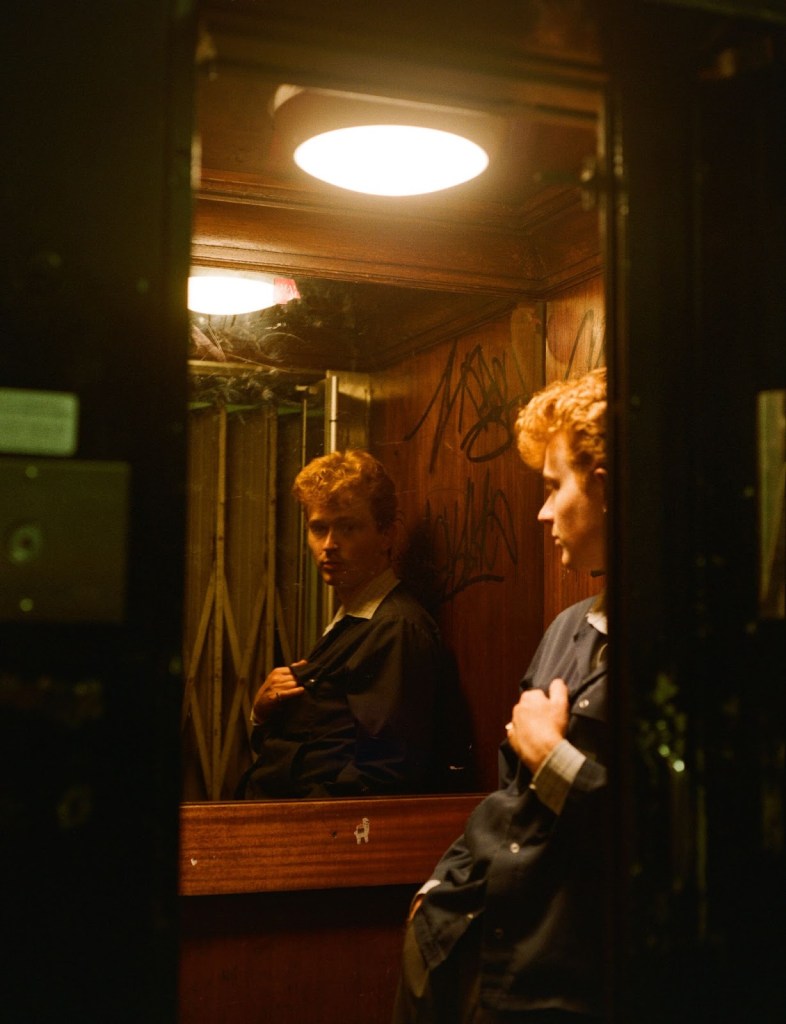
Ogborne is not one to take breaks creatively, at least not at the moment. Indeed, our interview started with a roll call of all of the other projects he is currently involved with outside of his own. As Norman came to an end, songs that would find their outlet in Bingo Fury were already gestating. He explains that ‘I’ll Be Mountains’ is “a development of one of the first things I wrote on piano,” marking this album’s origins to when he was around 19 or 20. “That low piano line and improvisation over the top of it” existed from the first phone demo, which fleshed out every idea that sprang to mind around the theme.
Though it is defined by his work on piano, there wasn’t too much conceptual loading that went into putting this album together. It feels more like a collection of “the songs that were around,” which had been accumulated in the time building up to it. “I find writing to be quite a constipated process. If a song gets to the point where it’s finished, it’s fucking battled to get there.” Of course, there has been some editorial consideration that has gone into this record, since it follows on from earlier Bingo Fury singles and the 2022 EP ‘Mercy’s Cut.’ He concedes the point, noting that the space in which the album was recorded, Cotham Parish Church, brought a lot to the tone of the record, as did the particular playing styles of his performers and the sequencing of these songs. As a whole, he feels “it reaches the extremes of the project’s intensity and melancholy in a way that I think makes sense,” even though he worried it might not necessarily come together that way.
‘I’ll Be Mountains,’ which he suggests was probably the hardest song to get right, was one of the tracks that only really came together as the recording process took place. It was, “The one moment where I almost… ‘lost it’ would be an exaggeration, but I was getting quite frustrated.” Ogborne explains that he did not actually play on the core track, instead conducting his players, Rafi Cohen (piano), Henry Terrett (drums), Harry Irvine (clarinet) Meg Jenkins and Harry Furniss (cornet), guiding them through its peaks and troughs of intensity. “I’ve never had to conduct before, so it was my weird traffic warden equivalent of conducting, which I wasn’t getting right… I was like, ‘I’m not sure I’ve got the skill to execute this right,’ even though I wasn’t playing anything.”
Happy with the final result of that freewheeling song, he looks back on it as a telling example of how the album felt its way into existence, something that he feels adds to its energy. “I think there’s something that happens where if a song is only established a certain amount, you can hear in the performances that everyone’s trying to understand the song as it goes. That brings a kind of urgency to it that’s not there if you’ve smashed out the song hundreds of times.” Ogborne speaks highly of the album’s contributors, pleased with how they continue to surprise and excite him with their playing. “In the lyrics, that’s where I want my articulation to be,” but when it comes to what they inspire in musicians, he enjoys that he is “not fully under the impression that I’m in control of it.” He gives the example of his drummer Henry Terrett, saying, “We’ve played together for fifteen years and still he’ll do something and I’m like, ‘Where the fuck did that come from?’ And it’s that feeling that keeps me excited.”
‘Bats Feet for a Widow’ releases this Friday via The state51 Conspiracy. By the sounds of it, there is plenty to look forward to beyond that. Not only has Ogborne been in the studio producing a new album from Naima Bock, he also has projects underway with The New Eves, Minor Conflict and Quade. Of his plans for Bingo Fury, he suggests that material for a new album is coming along nicely, and mysteriously explains, “I don’t think that there’s gonna be many traditional instruments on it, it’s gonna be more use of domestic objects. I’m tryna make a lush, orchestral record out of not-very-lush items.”

 Hard Of Hearing Magazine