
Ahead of the release of his third album ‘Critterland,’ Willi Carlisle talks circus tricks, accordion shops, and his own personal utopia.
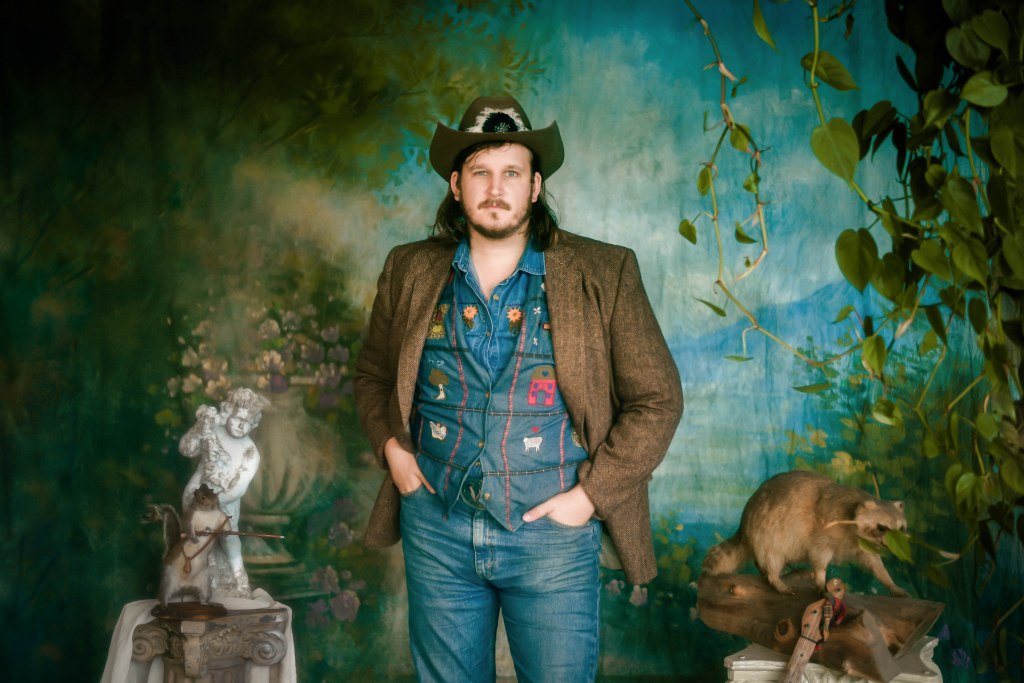
‘Sometimes there’s a script, but I never stick to it.’
Willi Carlisle is describing to me the theory behind a banana peel gag, something a clown once explained to him. “It’s fun to watch somebody slip on a banana peel but it’s not only funny that they hit themselves. It’s funny that they could not hit it, that they are definitely going to, and then that it actually happens.” The Missouri-based folk singer-songwriter finds this a useful analogue when accounting for his own burgeoning success as a live performer, magnetic in his conviction, his insightful commentary between songs and his ecstatic performance of the songs themselves. Singing about heartaches, utopian visions and tales of freedom pushed too far with wild eyes and unrestrained emotion and rotating from banjo to guitar to bones to accordion and back again, you can’t take your eyes off him. Between songs, the flow doesn’t stop either. He barrels through stories behind the songs, veers off on tangents, forgets details and makes others up – all at lightning pace. “Sometimes there’s a script, but I never stick to it; I’ll mess up a story a dozen times.” Carlisle is open to mistakes, willing to risk scattering some playful misinformation in the communication of the higher truths his music pursues. “Watching somebody teeter is fun, is interesting… I’m here to invite chaos.”
We caught Carlisle just before Christmas, winding down from a year in which he spent 9 months on the road and released his second album ‘Peculiar, Missouri.’ This month, he releases another album, ‘Critterland,’ recorded in a four-day burst somewhere in the middle of that schedule with Grammy-winning producer Darrell Scott.
It’s a chaotic way of life, but Carlisle thrives off chaos. “We used to play this stupid game… it worked best with drunk artists in particular. You’re dancing. Somebody says, ‘Bring it to 5’ and then you’re supposed to dance at a level of 5 out of 10 of intensity and control. 0 is fully intense and no control and 10 is in control and not intense. At 10, you’re being very controlled, almost robotic, and then when you go to a 0 you’re like, entirely out of control.” Carlisle sees his musical performances in these terms, too. “I am best at 0. I actually have a lot of trouble with anything above 5 or 6, before I sound stiff.” It is very Willi Carlisle of him at this point to explain that he learned this about himself when he played tenor banjo in a Western Swing band, trying to keep rhythm.
‘Critter, Critter!’
Turning back to ‘Critterland,’ one can see that it is in the terms of chaos that Carlisle engages with the world. Though he does not always glorify its manifestations, even the more troubled details of songs like ‘When the Pills Wear Off,’ ‘The Arrangements’ and the maniacal ‘The Money Grows on Trees’ show an empathy with their subjects, capturing the temptations to which they succumb. These songs play off against the more utopian visions, such as the outlaw’s gospel of ‘Higher Lonesome’ and the utopian title track.
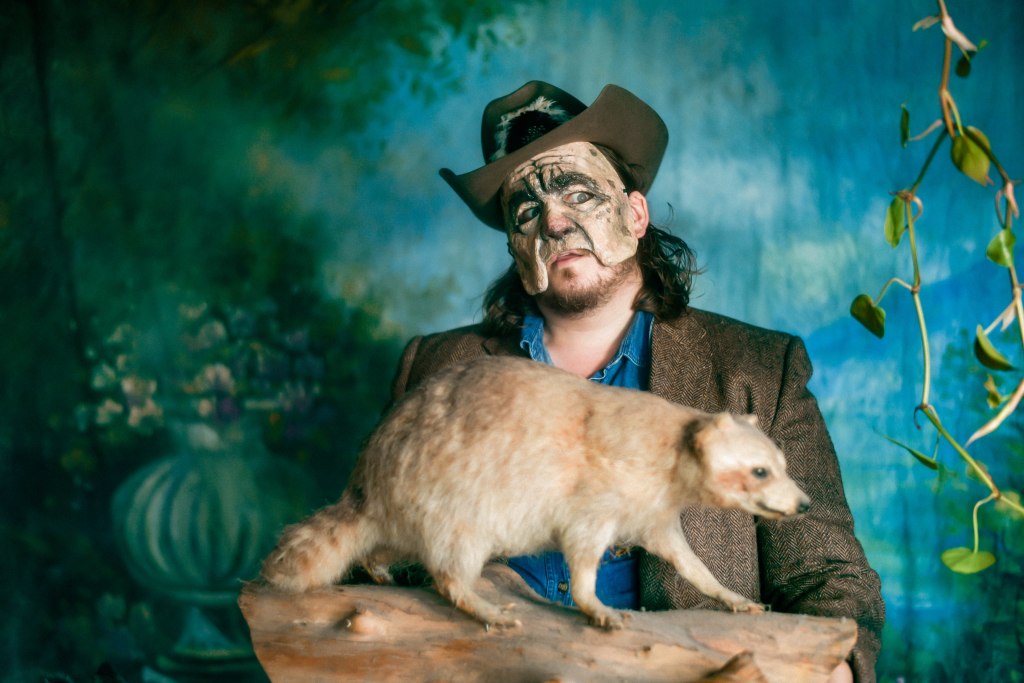
The ‘Critterland’ Carlisle derives from a real intentional community, Meadow Creek, which he very nearly joined during the pandemic. It is built on anarchist values that he saw as exciting but also a necessary challenge to how he thought. Though he ended up conceding his spot to people who needed it more and were more willing to live in those ascetic conditions, he did spend a lot of time at Meadow Creek fixing up living quarters. The idea of such a place remained as an important spark in Carlisle’s imagination. ‘Critterland’ became a “colloquial name for my own dream,” inspired by the amazing wildlife surrounding Meadow Creek and a game played among that community where if you saw an animal crossing the road, you’d shout, “Critter! Critter!” and nominate someone to ‘chug a beer and remove an item of clothing.’
Beyond the appeal of the specific political ideals of the Meadow Creek community, which ‘ground up’ the points that divide us in Late Capitalist Western society, was a conviction that “it’s vital that different ways of thinking find their place.” Central to the stagnation of American political discourse right now is that years of divisive politics and cultural atomisation have meant people with different views find themselves with no means of to bridge their boundaries. Meadow Creek was a challenge to Carlisle. He thought to himself himself, “When you get raised with Spongebob and Nintendo 64 and 10,000 Froot Loops ads you’re gonna be like, ‘Is what I’ve thought the only way to think?’” Meadow Creek is a rare place he found a group of people, not just individuals, who “really don’t think the same,” a “meaningful alternative” to “Late Capitalism’s apocalyptic end run.” It wasn’t perfect, and alongside practical obstacles, he’s “not sure he could have hacked it,” but it was clearly a worthwhile experiment.
“Several dozen shows in the general direction of home.”
Carlisle’s success tells the sort of romantic folk singer journey many would dismiss as impossible these days, built on years of honing the appropriate level of chaos at his live shows and continuing to grow by word-of-mouth. Though bolstered by the small-scale viral success of his session performance of ‘Cheap Cocaine’ for Western AF (currently sat at 1.6M views on YouTube) his growth has largely come from connecting with people through live shows, something he has always loved to do. Life on the road is celebrated in all its bittersweetness and hardship across his work, especially in recent tracks ‘Vanlife’ and ‘Peculiar, Missouri.’ Elusively, he comments, “Home’s not easy for me, travel’s a little simpler.”
Carlisle found an outlet for this proclivity in his early days when he was involved in theatre, touring plays to fringe festivals across North America and playing shows along the way home. “It would be like if we ended up in Toronto, or something, and we finished our shows there, I would just book several dozen shows in the general direction of home – kinda beg and borrow. I’d end up in a city for sometimes as much as two weeks waiting between shows, either staying on a friend’s couch or living in a car.”
Today, the allure of touring still charms Carlisle. Though he is “trying to become less of a road dog,” he still “tends to salivate” when a gig offer comes in. He now works with a tour manager, a necessity for dealing with the workload of more traditionally structured/booked tours and also a valuable spiritual companion: “I takes a little better care of myself when there’s someone else around, I do fewer dumb things.”
“This was a lifestyle and it’s turned into a small business, and that’s weird. My core values are not very aligned with running a business. They’re aligned with: If I spend time in a city I’m gonna go to the accordion shop and learn how to repair this accordion by just bothering this guy over here.” Reflecting on one of his more quixotic endeavours on the road, he tells of spending a week and a half in Juno, Alaska “just making friends… I still think about my Alaskan friends all the time.”
As his audiences grow, however, Carlisle is finding it harder to create the “human scale” resonance that folk music should work on. Though generally gets to know people who come back to 3 or 4 shows, he doesn’t get a chance these days to hang out with everyone in his audience after a set. That said, the circus vulnerability of his “teetering” performances, especially those unmoored by a band, capture the human effort that goes into keeping the show rolling. Offering another big top metaphor, he explores the appeal of the Strong Man act. “To me it doesn’t matter if the Strong Man is lifting a pile of straw; you’re there for the show.”


 Hard Of Hearing Magazine