
With her debut single, the artist alternates between a sharp warning and an empathetic, hovering, benediction.

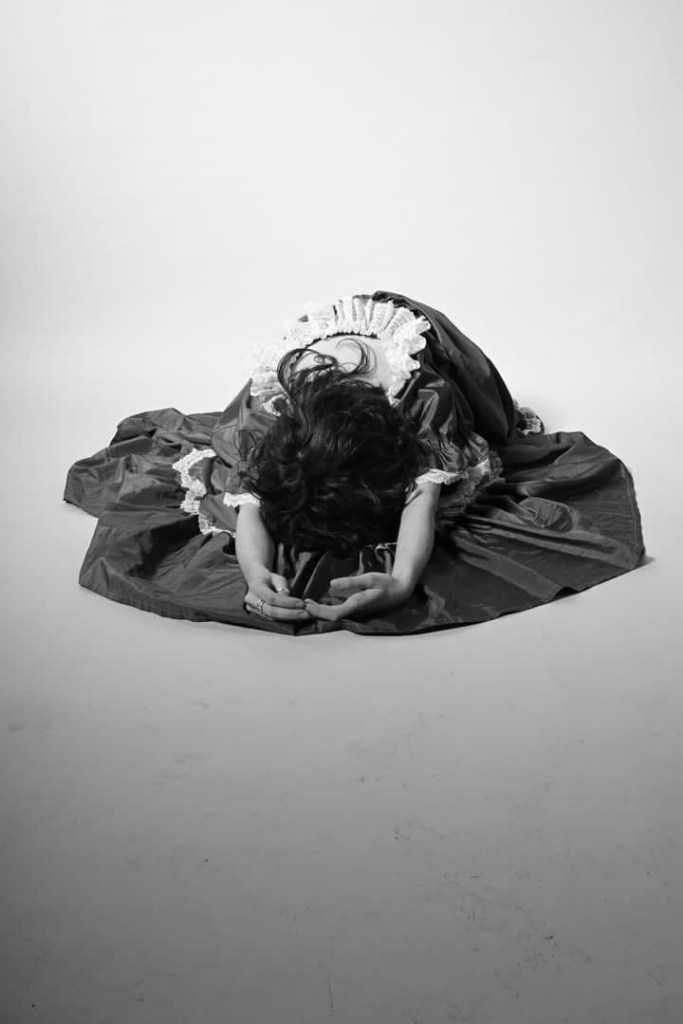
“What’s in a name?” One of the countless lines of Shakespeare that have been tossed around constantly for the last few centuries, and a theory blown to dust and ashes by Scarlett Woolfe, whose name fits her like a made-to-measure suit. (Le smoking.) Her debut single “Poor Suzy,” features lyrics that tackle longing, alienation, and desertion and that read like fragmented Gothic poetry, sung with a glorious anarchic abandon. With her auburn curls and manic intensity, Scarlett Woolfe’s voice takes the ancient Gaelic tradition of the keen into modernity. In ‘Poor Suzy,’ it’s a searing banshee howl that turns appropriately to a caress as the lyrical narrative alternates between a sharp warning and an empathetic, hovering, benediction.
I first met with Woolfe to discuss, ‘Poor Suzy,’ nearly twelve months ago, on the first day of the year. She was hunkered down in her mother’s cozy magpie nest of a cottage in Yorkshire to work on the single, and exuded a hypnotic, hyper-focused confidence, a fiery blaze of red hair billowing up in pre-Raphaelite ringlets around her elfin face. I found myself drawing correlations between the symbolism of red hair – in poems, in books, in films and paintings – and the character of Suzy that Woolfe had brought to life in the track and has embodied so frequently onstage. Red hair symbolizes the unquenchable, the irrepressible; even five-year-olds know the innate power of it, in the form of fire, or the sun at the centre of our solar system. Red hair cannot be tied down, kept at home, or trammeled like a bird in a cage. Red hair echoes rebellious hope springing eternal through the mire of navigating womanhood in a patriarchy.
As the only child of a writer, Woolfe’s nomadic childhood included a brief spell living in the American Midwest, but the majority of her adolescence was spent in Suffolk, in the English countryside. It was aged 15, on holiday in France at the home of a family friend (“…a shed in the middle of nowhere…”) that out of sheer boredom, Woolfe first picked up a musical instrument. The only choices in the shed (which had no cell signal, infuriating the teenager, who only wanted to check her messages) were an accordion and a guitar: “I tried the accordion, and it was a nightmare, I couldn’t work it out. Then I picked up the guitar, and I started playing.” She hasn’t stopped since.

Having come fully under the spell of music, Woolfe joined a shoegaze band called Hether, which was mostly “…lots and lots of writing, songwriting for other people…I did a bit of acting, and a bit of directing, and just sort of tried everything, very sort of early twenties confused-about-who-I-am.”
Now, Woolfe writes for herself. Of ‘Poor Suzy,’ Woolfe says, “… the imagery and the initial part of it came years ago. Maybe three or four years ago. But not the actual sound of the song, and this image that stuck in my head, and this sort of character that I called Suzy stayed within my psyche.”
“When you write about anything, it comes from some part of yourself and for me there’s this feeling of dissociation and this feeling of feeling dead even though you’re alive. I think a lot of women go through periods like that, some more than others, and there’s this natural disconnect, like in the John Berger ‘Ways of Seeing’ stuff, especially about how women are always being watched…I think that can cause us to sort of close off, and I’ve had that experience a lot. Seemingly beautiful, seemingly alive, and dressed up and ready but just completely dead inside, not really present, not really able to interact or be there, this feeling of emptiness, which I feel correlates.”
It’s a year after our Zoom meeting, the track has finally been released and Woolfe’s hair has gone from red to a rich auburn, which seems fitting, somehow. Bringing to life songs peopled with such powerful characters as Suzy is a tricky business — often, characters will trap you until they trap them, roping you into their service, immersing you in their creation. Now, Suzy is out in the world, the lock has been sprung, and Scarlett Woolfe is free to summit her next triumph. Her songs, like her eerily captivating stage presence, give you the sense that she’s poised to run straight up some invisible ladder into the sky to pick a fight with God—and that you’d be a fool to put your money on anyone but her. It’s Scarlett Woolfe for the win.




 Hard Of Hearing Magazine