
The group process traditional Hindustani elements through the forms of pop and garage.
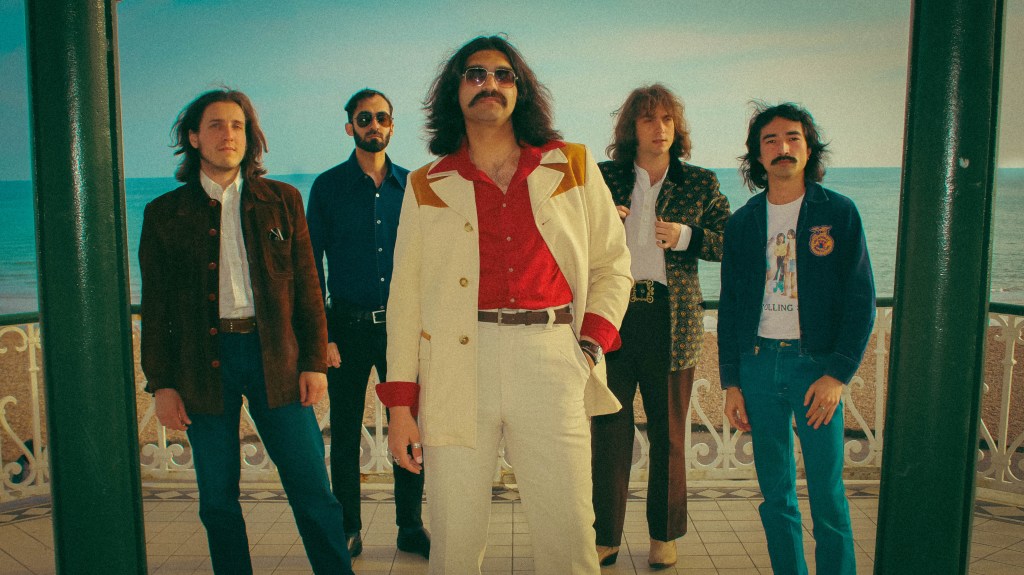
Karma Sheen’s debut self-titled album is a phenomenal modern iteration of the drone – pulling traditional approaches into the present – alongside psych sounds of King Gizzard, Anatolian Psych, and fellow Londoners GNOB. Rather than the mind-warping effects these aforementioned psych groups induce, however, Karma Sheen generate a far more mind-settling potency, in which all sense of time and space slowly subsides. Throughout album’s focused yet flexible sonic menu, this dronal elemental force comes from the incantatory vocals, entrancing sitar, and lysergic haze of the guitar.
Besides the instrumental jous the sitar decorates Karma Sheen in, it’s source – sitarist Rod Bourganos – was the catalyst to the band’s formation, after fortuitously meeting frontman and vocalist/guitarist Sammer Khan.
The Western experimentalism of the East London band diffuses in the combination of drone and melody brought by the sitar. Like the band’s proposition, the sitar constitutes a perfect blend of modernity and tradition. Although parts embark upon evocative, Ravi Shankar-style ragas, there are also subtler stylistic wisps hinting at Bourganos’ varied sitar study in Brazil and Singapore. This sitar-based detour and calibre is most keenly felt on ‘Mian Ki Jive,’ where intuitive, quicksilver notes mirror the vocal melody like a trippy shadow: the sitar, as you’ve never heard it before, only equalled by the sensational guitar solo that follows.
Although less heavy, more psychically drone-infused, Karma Sheen demonstrate a similar tensile discipline as GNOB, in sticking rigidly (yet still remaining explorative) to a key, hypnotic melody. However, the mesmeric tone of the band doesn’t let up when they segue into new sections, retaining characteristic looseness. See the sitar-laden lope of the opener for the exquisite skill the instrument is performed with, serendipitously taking the track into new realms.
Later track ‘Bageshree’ is doubly potent in drone, as sitar and wah-wah guitar bleed into each other’s stupefying arcs. Just as startling and nuanced, its tempos alternate with unending glee, moving more spontaneously than any that influence Karma Sheen.
Subsequent raga ‘Alap Bageshree’ is their greatest display of vocal majesty, as Khan’s throaty oscillations echo an intimately spiritual Vedic chant, the frontman becoming a contemporary Pandit Pran Nath.
Birdsong on ‘Sameer’s Sunflowers’ is just as welcome as the sitar in Karma Sheen’s world, sparking vicarious enlightenment. It unfurls elegantly, the avian ornaments flowing into other beguiling samples, buoyant sitar, and the gossamer-rich vocals the eponymous singer deploys. Like Bourganos, Khan had an enriching musical education, learning Hindustani classical music in Pakistan from the historic Shaam Chaurasi Gharana school. Here, his chant is far more lyrical, akin to the kind you might hear in Beatles deep cuts, but adding greater nuance through rhymes that percolate a deep wooziness. These primordial English lyrics mix with his East Asian vocal style to embody Khan’s superb range.
Elsewhere, his voice paints lurid, expansive tapestries in Arabic – as on ‘Homecoming.’ The vocals here are an emotive, resonant companion to the sitar, cruising the track into a scintillating reignition of the raga, all juddering bass, angling sitar, and classic rock fervour-doused guitar. The final suite is the only one (of the whole album) that feels somewhat jarring. Nevertheless, its melody is iridescently beautiful.
Although there is haunting beauty across Karma Sheen, there is also sufficient discord sown, broadening its musical, spiritual spectrum. Closer Alap Jog drapes earthy, ominous drone over the pained vocals while ‘Sameer’s Sunflowers’ delivers a raw, scorching solo – the instrument sobbing as though it was the relative of Hendrix’s cremated axe.

 Hard Of Hearing Magazine