
We explore the enigmatic soundscapes of Goat’s fifth studio album, where psychedelic folk meets deep reflection.
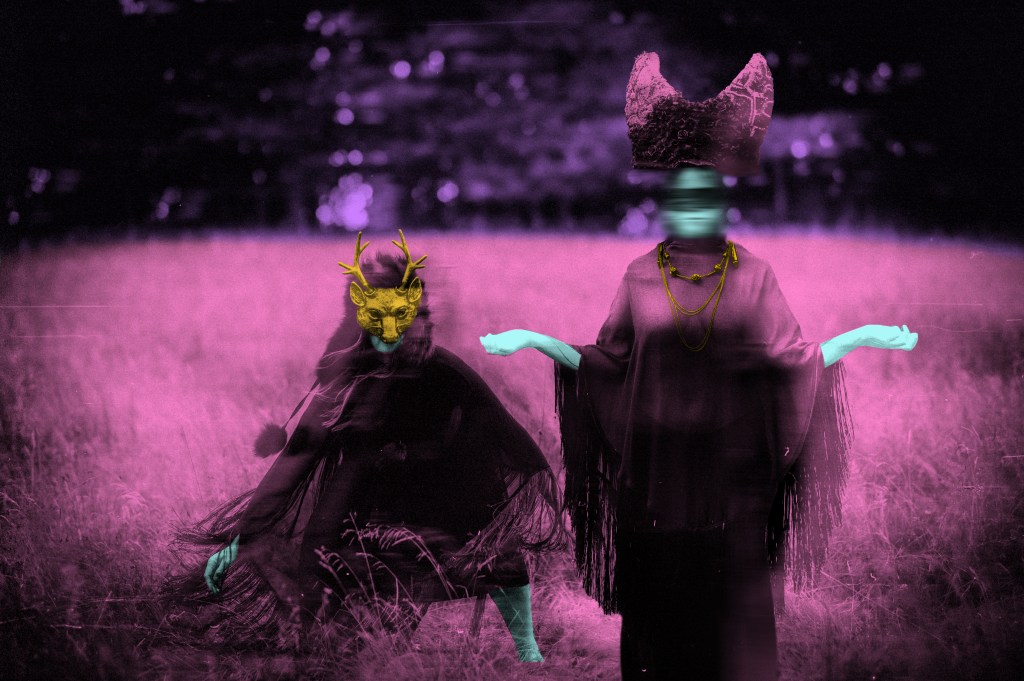
Goat, the band/occult phenomenon of the early 2010s, originated in the obscure Swedish village of Korpilombolo. Their sonic concoction blended fairy folk fireside rituals, doomish, early Sabbath-type riffs, and a fascination with world music—a style supposedly inspired by an voodoo curse cast upon their hometown. Their new album ‘Medicine’ now stands as a testament to the band’s evolution, echoing their earlier works while venturing into new realms.
The album unravels as a spectral journey, haunted by mysterious images on the fringes of dark arcane forest portals, otherworldly elements beckoning the listener into this different realm. ‘Medicine’ distinguishes itself by a deliberate shift in focus. While its predecessors heavily leaned on beats from around the globe, this album boldly delves more decidedly into the tropes of psychedelic rock.
‘Medicine’ is a swirl of fuzzed-out face-melters, nasal Osborne vocals, and world music beats that traverse the waves once again. It’s more straight-up than previous albums, for better and for worse. Tracks like ‘Raised by Hills,’ ‘I Became the Unemployment Office,’ and ‘Tripping in the Graveyard’ showcase Goat at their zenith, scratching that elusive psychic itch for arcane rock-n-roll with its very overt homages to classic rock tropes.
As ‘Medicine’ unfolds, the listener is enveloped in a world where the veil between worlds is tantalizingly thin. Goat beckon the audience to delve into the impermanence of life, exploring themes of sickness, relationships, love, death, and the finite nature of existence. The lyrics remain cryptic, but the emotive depth of the music speaks volumes. Goat draws inspiration from Swedish psych, prog, and folk acts of the ’70s, though the group insist that the album’s creation was an organic process, free from conscious imitation.
The haunting shrill of the flute takes centre stage across ‘Medicine,’ weaving its ethereal presence into tracks like ‘Impermanence and Death’ and ‘You’ll Be Alright.’ ‘TSOD’ shows off a different side to the sound, sounding almost like a lost George Harrison recording with its sitar and acoustic guitar. The album’s closer, ‘Tripping In The Graveyard,’ places the flute at the forefront, leading the melody into a mesmerizing conclusion.
‘Vakna’ pays homage to ’70s Swedish psych-folk with swaying guitar solos, creating an atmosphere tailor-made for twilight festival performances. The album culminates in a captivating coda of chants and bells, reminiscent of Goat’s paganistic folk soundtrack for Shane Meadows’ “The Gallows Pole.”
‘I Became The Unemployment Office,’ prompts contemplation on the complexities of human relationships. Goat encourage listeners to dissect acts of kindness that may be perceived as entitlement, a theme woven into the fabric of ‘Medicine.’ The album serves as a thought-provoking sonic journey, inviting introspection and encouraging exploration into the depths of one’s own existence.
The enigmatic history of Goat, stretching back decades to Korpilombolo, adds an intriguing layer to their narrative. Yet, a mere eleven years after their debut, ‘Medicine’ emerges as a testament to the band’s ability to reinvent while remaining true to their distinct sound. This fifth album is a musical odyssey that effortlessly marries folk-rock roots with the hypnotic sounds of the flute and the cosmic echoes of psychedelic exploration. Like some bewitching potion, ‘Medicine’ invites those who imbibe to lose themselves in its labyrinthine depths.


 Hard Of Hearing Magazine